




































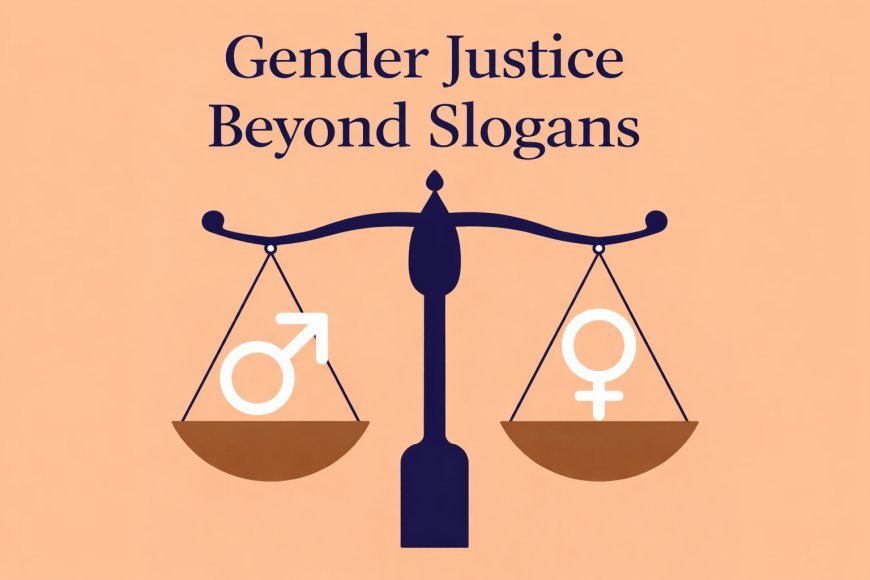
Gender Justice Beyond Slogans

By : Dr. Sashi Sekhar Samanta.
In recent years, gender justice has become one of the most frequently invoked phrases in public discourse. It echoes in election speeches, policy documents, corporate mission statements, and social media campaigns. Slogans promise empowerment, equality, and dignity. Yet for millions of women, especially those at the margins, gender justice remains a distant aspiration rather than a lived reality. The growing gap between rhetoric and reality raises an uncomfortable question: has gender justice been reduced to a slogan rather than a commitment?
True gender justice is not achieved by symbolism alone. It is not delivered by hashtags, commemorative days, or well-worded government advertisements. It is measured by outcomes—by whether women are safer in public and private spaces, whether they have equal access to education and employment, whether unpaid care work is recognised, and whether institutions respond swiftly and fairly when women seek justice.
Despite constitutional guarantees of equality, structural barriers continue to define women’s lives. Economic participation remains unequal, with women disproportionately concentrated in informal, low-paid, and insecure work. Even when women enter the workforce, wage gaps persist, leadership positions remain elusive, and workplace safety is far from assured. Laws exist, but enforcement is uneven. Committees are formed, but accountability is rare.
Perhaps the most troubling aspect is the selective nature of outrage. Gender justice is often loudly defended when it aligns with political convenience and quietly ignored when it challenges power structures. Crimes against women from disadvantaged communities—rural women, tribal women, migrant workers—rarely receive sustained attention. Justice, when it comes at all, arrives slowly, diluted by delay and indifference.
The burden of proving injustice also falls unfairly on women. Survivors of violence are expected to display resilience, restraint, and credibility, while institutions tasked with protecting them often operate with suspicion or apathy. Social stigma, fear of retaliation, and prolonged legal processes discourage many from even seeking redress. In such an environment, slogans ring hollow.
Gender justice also cannot be separated from social and economic justice. A woman denied land rights, healthcare, or education cannot meaningfully access legal equality. Welfare schemes, though necessary, often treat women as beneficiaries rather than rights-bearing citizens. Empowerment framed as charity weakens the very idea of justice. What is needed instead is a rights-based approach that places women at the centre of policy design and implementation.
Another challenge lies in the performative use of gender language. Institutions proudly adopt the vocabulary of equality while continuing practices that reinforce discrimination. Representation is showcased, but decision-making power remains concentrated elsewhere. Inclusion becomes cosmetic, not transformative.
Equally important is the role of society itself. Gender justice cannot be outsourced entirely to the state. Deeply ingrained attitudes—normalising domestic violence, policing women’s choices, burdening them with unpaid labour—undermine legal progress. Education systems, media narratives, and community leadership must actively challenge these norms rather than reproduce them.
Moving beyond slogans requires courage and consistency. It demands investment in education, healthcare, and legal infrastructure. It requires independent institutions that function without political pressure. It calls for data-driven policy, not token gestures. Most importantly, it requires listening to women—not just as victims or symbols, but as citizens with agency, experience, and voice.
Gender justice is not a seasonal theme to be revisited on symbolic occasions. It is a continuous process that tests the moral credibility of a democracy. When equality is reduced to language without action, it breeds cynicism and erodes trust. When justice is delayed or denied, it weakens not only women but society as a whole.
If gender justice is to mean anything beyond a slogan, it must be visible in everyday life—in classrooms and courtrooms, in workplaces and homes, in laws that work and institutions that respond. Anything less is not justice, but performance.