

































IMFA

By |Dr. Satyabrata Jena |
Subsidies, and the Price Odisha Pays: Questions That Demand Answers
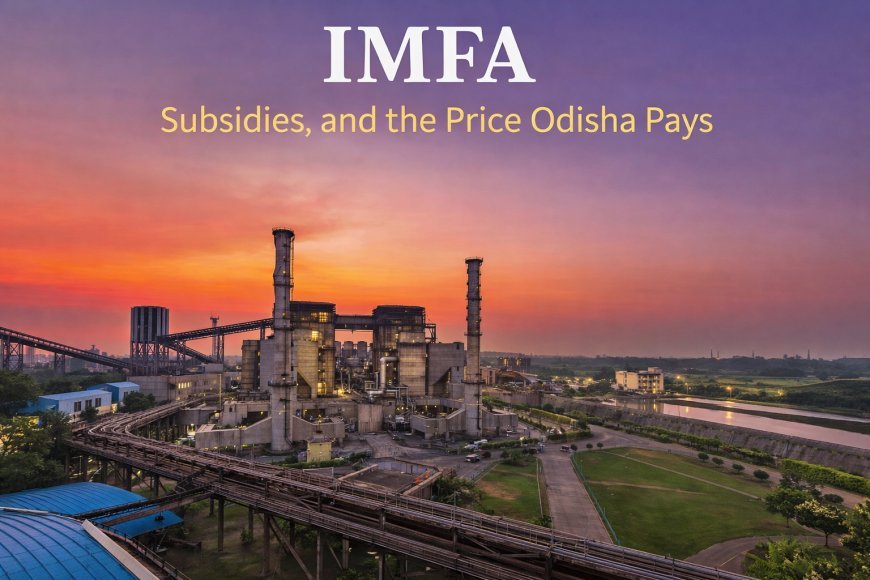
Industrial growth is often presented as a marker of progress. In Odisha, few companies symbolise this promise as prominently as Indian Metals & Ferro Alloys (IMFA)—a major ferro-alloys producer with decades of presence in the state. Yet alongside expansion, exports, and policy support, a growing public unease has emerged. Allegations, protests, and policy debates have coalesced into what many citizens now describe as the “IMFA issue”—not a single proven crime, but a web of concerns around subsidies, environmental costs, local livelihoods, and political proximity.
This editorial does not pronounce guilt. It asks questions that a democracy must ask when public resources, private profit, and people’s lives intersect.
The Subsidy Question: Who Benefits, and Why?
At the heart of the controversy lies government support—power subsidies, mineral linkages, infrastructure facilitation, and policy incentives extended to large industrial units. Such support is not unusual. States across India court capital to generate jobs and revenue. The issue arises when subsidies appear generous, prolonged, or insufficiently scrutinised, especially in sectors that are energy-intensive and environmentally sensitive.
Critics argue that IMFA has benefited from preferential electricity tariffs and policy reliefs at various points, even as ordinary consumers face rising power costs and small industries struggle with access. Supporters counter that incentives are standard industrial policy tools, tied to investment commitments, exports, and employment.
The unanswered questions are simple:
What is the full quantum of subsidies and concessions received over time?
Were these time-bound and performance-linked?
Have public audits assessed cost versus benefit to Odisha’s economy?
Transparency, not rhetoric, is the missing piece.
People on the Ground: The Human Cost Debate
Beyond balance sheets, the most persistent disquiet comes from communities living near mining belts and industrial corridors linked to ferro-alloys production. Farmers, forest dwellers, and informal workers have repeatedly voiced concerns about:
land acquisition and displacement pressures
environmental degradation affecting agriculture and water
health impacts from dust and emissions
uneven employment opportunities for locals
While companies cite compliance and CSR initiatives, residents often describe a gap between promises and lived reality. For those who lose land or see livelihoods erode, compensation feels temporary against permanent change.
Industrialisation cannot be reduced to permits and profits; it must be judged by outcomes for people.
Environment and Compliance: Law vs. Lived Impact
Ferro-alloys manufacturing is power-hungry and polluting by nature, demanding strict compliance. Regulators issue clearances, monitor emissions, and mandate mitigation. Yet enforcement capacity is uneven, and penalties—when imposed—rarely reassure communities that harm has been reversed.
The concern is not whether IMFA holds approvals, but whether regulation is robust enough and enforcement independent enough to protect public health and ecology. Environmental compliance must be continuous, not episodic.
If monitoring is strong, publish the data. If violations occur, disclose actions taken. Opacity fuels suspicion.
Politics and Proximity: The BJP Government Question
Public debate has intensified around the perception that the BJP-led government at the Centre has been especially supportive of large corporates, including IMFA. This is a national conversation, not an Odisha-only one. Industrial policy under the BJP emphasises scale, exports, and ease of doing business.
The concern is not support per se, but selectivity and accountability:
Are incentives even-handed across firms and sectors?
Do politically influential companies enjoy faster clearances or softer scrutiny?
Are state interests subordinated to corporate lobbying?
Perception matters. When people believe that proximity to power shields firms from scrutiny, trust erodes—regardless of legal compliance.
Employment: Promise vs. Reality
Supporters of IMFA point to jobs created, both direct and indirect. Critics respond that many positions are contractual, low-wage, or non-local, while traditional livelihoods decline.
A fair assessment requires data:
How many permanent local jobs were created?
What skill transfers occurred?
How resilient are these jobs to market shocks?
Industrialisation that displaces more livelihoods than it creates is not development—it is redistribution without consent.
The Accountability Gap
What transforms industrial policy disputes into alleged “scams” is often the absence of clear accountability. When subsidy terms are opaque, audits delayed, and grievances unresolved, narratives harden.
Odisha needs:
Public disclosure of all subsidies and concessions to large industries.
Independent audits assessing economic, social, and environmental impact.
Time-bound grievance redressal for affected communities.
Legislative oversight that asks hard questions without fear or favour.
Accountability protects honest companies as much as it protects citizens.
Industry’s Responsibility: Beyond Compliance
Large companies operate on social licence, not just legal licence. IMFA—and firms like it—must go beyond minimum compliance to build trust:
publish impact data proactively
engage communities continuously
align CSR with local priorities, not optics
accept scrutiny as the cost of scale
Silence or defensiveness deepens distrust.
Development Must Answer to the Public
The IMFA controversy in Odisha is not merely about one company. It reflects a broader dilemma: how should India pursue industrial growth without sacrificing fairness, ecology, and democratic oversight?
Subsidies are public money. Minerals are public assets. Air and water are shared goods. When any of these are leveraged for private profit, the public deserves full answers—not slogans.
Odisha can and must industrialise. But development that demands silence is not progress. Development that welcomes scrutiny is.
The questions around IMFA will not disappear with denial or delay. They will be resolved only by transparency, accountability, and a willingness—by government and industry alike—to place people at the centre of policy.