






























Nation Building: Beyond Statues, Ceremonies, and Spectacles

In 2015, during a seminar on the topic “What is God?”, I began with a simple question to the audience:
What came firs—creation or the Creator?
The intuitive answer was Creator. And yet, the stories of Sri Rama or Sri Krishna begin after creation. They arrived within creation, as guiding forces—not as creators, but as exemplars.
Sri Rama is not worshipped merely as “God,” but as Purushottam—the ideal human being. He exemplified:
Duty and righteousness
Compassion and courage
Sacrifice and devotion
Kingship with humility
Husbandhood with purity
Brotherhood with loyalty
Even being the Supreme Lord, He voluntarily accepted human limitations to set an example. That is the greatness of Rama: he built character, not monuments; he built values, not vanity; he built Ayodhya by building people first.
Today, we admire Rama not because he built the tallest statue, but because he built the tallest standards of humanity.
The Era of Symbolic Nation-Building
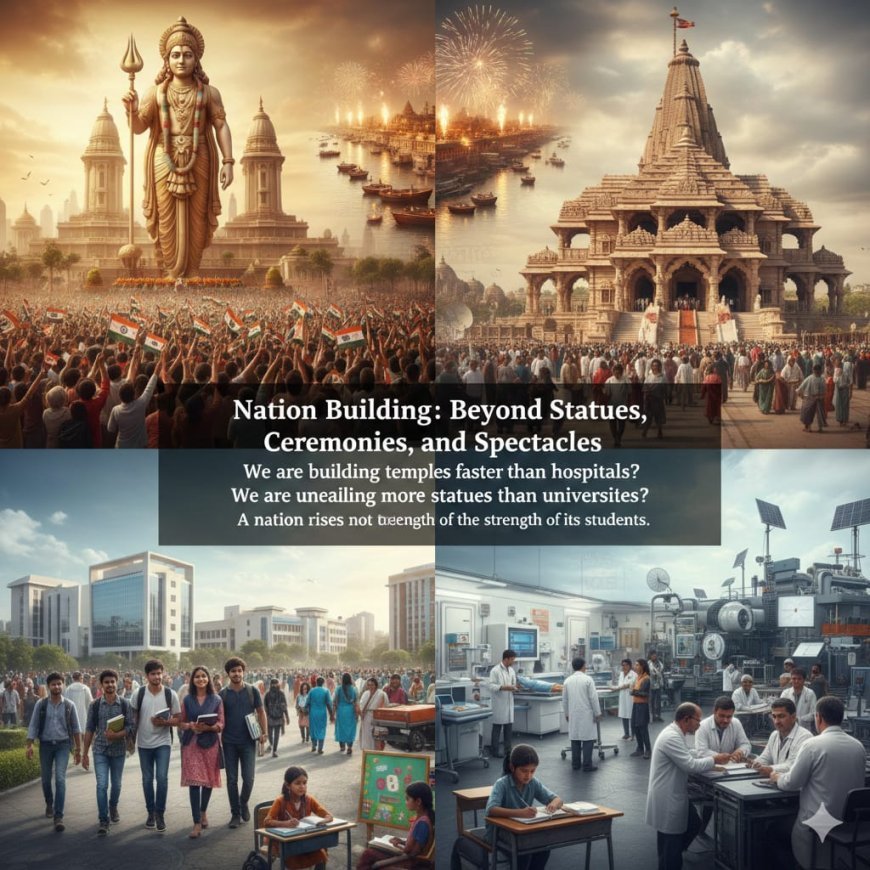
On 28 November, Prime Minister Narendra Modi unveiled the world’s tallest 77-foot statue of Lord Ram in Goa. It is a grand symbol. But symbols cannot replace substance.
We have witnessed many such spectacles:
World’s tallest statues
World’s largest gatherings
World’s biggest riverfront ceremonies
Mega inaugurations of temples and corridors
But here is the uncomfortable question that every citizen must ask—not politically, but patriotically:
Have we seen similar pride or priority in:
The world’s largest hospital?
The world’s largest university?
The world’s best public school system?
The cleanest, safest cities?
The most advanced scientific research hubs?
New AIIMS, new major universities, or major national institutions on the scale of IITs/IIMs/JNU?
We all know that AIIMS, IITs, NITs, IIMs, CSIR labs, ISRO, DRDO, atomic research centres—all these institutions were built long before 2014.
So the question naturally arises:
Why are we unveiling more statues than universities?
Why are we investing more in symbolism than scientific infrastructure?
Why are we building temples faster than hospitals?
These are not questions against any leader.
These are questions for every Indian who dreams of a truly great nation.
The Reality: Nation-Building Requires Substance, Not Spectacle
Rama built Ayodhya not by erecting his own statue, but by:
Ensuring justice for every citizen
Providing welfare for the weakest
Strengthening institutions
Upholding ethical governance
Prioritizing the people over personal glory
True nation-building is quiet, slow, and often invisible.
It requires:
Teachers more than temples
Researchers more than rallies
Doctors more than devotees
Innovators more than influencers
A great nation is never built on emotions alone, but on education, health, innovation, and infrastructure.
This is why the countries we admire—Japan, Germany, South Korea, USA—focus on:
Universities
Research
Manufacturing
Human capital
Public systems
A tall statue cannot treat a sick child.
A grand corridor cannot educate a farmer’s son.
A massive rally cannot produce a scientist.
Only institutions can.
The Purpose of This Article:
Not to criticise, but to awaken.
Every Prime Minister, including the present one, has strengths and weaknesses.
Every government does some things well and fails in some others.
But the citizen’s responsibility is to ask the right questions.
Democracy is strongest not when citizens clap,
but when citizens question with courage and conscience.
The future of India will be shaped not by the height of statues,
but by the height of our expectations from our leaders.
If we expect symbolism, we will get symbolism.
If we demand substance, we will get substance.
Nation Building Begins in the Minds of Its People
Let this article not end as a criticism of one leader—but as a challenge to all of us.
Are we demanding new IITs or new idols?
Are we supporting research labs or religious rallies?
Do we measure progress by GDP or by grand events?
Are we rewarding performance or popularity?
As long as we celebrate spectacle more than substance,
we will get leaders who give us spectacle.
Rama taught us that greatness comes from character, not display.
Ayodhya was ideal not because of temples, but because of its values.
A Ram Rajya cannot be created with inaugurations;
It can be created only with education, ethics, and equality.
Conclusion:
If we truly want a great India, we must think like Rama, not just worship him.
A nation rises not on the strength of its statues,
but on the strength of its students.
Not on the glory of its ceremonies,
but on the glory of its classrooms.
Not on the noise of rallies,
but on the silent dedication of researchers, workers, teachers, and doctors.
Let us think.
Let us question.
Let us rebuild.
Because true purushottam is not one who builds his own image—
But one who builds a great nation.
Sanjay Pattnayak
Sundargarh