
































Cuttack’s Heritage on the Brink: Can the Old City Survive New Pressures?

By |Sashi Sekhar Samanta |
Cities seldom lose their heritage in one dramatic moment. The loss comes quietly—through the slow collapse of an old building, the disappearance of a craft, the filling of an ancient canal, the widening of a road that erases a century-old neighbourhood. Cuttack, Odisha’s historic heart, is living through this quiet erosion. Once the seat of empires, trade, scholarship, and culture, the millennium-old “Silver City” today finds itself struggling to protect its identity under the growing weight of urban expansion.
The question is no longer academic or sentimental. It is urgent: Can Cuttack’s old city survive the pressures of modern development?
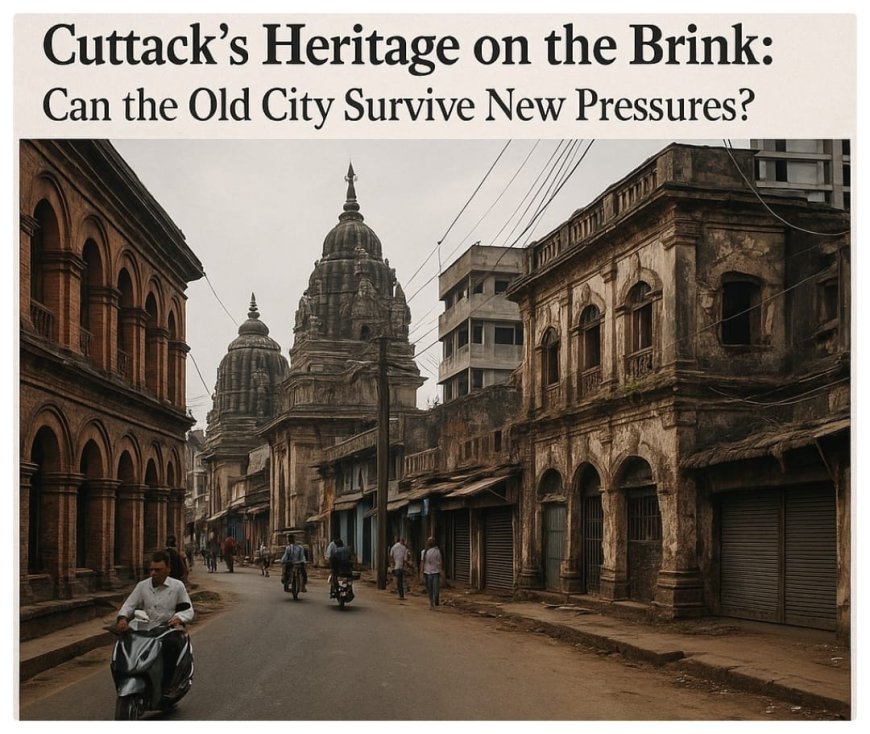
A 1,000-Year Legacy Under Threat : Cuttack is not simply “one more old city.” It is a rare, living palimpsest of Eastern Indian history. From the Keshari dynasty to the Mughals, the Marathas, and later the British, each era left behind architectural layers—temples, mosques, medieval gateways, colonial buildings, traditional marketplaces, and the iconic barabati fort wall that once guarded the Mahanadi delta.
But look closer today: The moat around Barabati is silted, encroached, and almost forgotten. Ancient temples are squeezed between concrete clusters. Historic neighbourhoods like Choudhury Bazaar, Balu Bazar and Dargha Bazar are choking under pressure. Traditional crafts—like silver filigree, pattachitra, and stone carving—struggle against cheap industrial imitations. British-era buildings are collapsing one monsoon at a time, with little intervention. The tragedy is not that heritage is aging; the tragedy is that it is aging without protection.
Urban Pressures Are Accelerating the Decline ,Cuttack today is a city caught between two forces: its living, breathing history and the demands of a rapidly modernising urban society.
Explosive Commercialisation : Markets are expanding, footfall is rising, and land prices are skyrocketing. Narrow lanes built for pedestrians now choke with motorbikes, vans, and delivery traffic. Shops extend into streets, homes convert into warehouses, and heritage structures are sacrificed for real estate.
Congested Infrastructure : The old city is a dense maze—beautiful, but fragile. Sewage lines, water pipes, drainage systems, and electrical grids are all overburdened. Flooding is now a seasonal reality. A city that once lived harmoniously with its rivers now finds water entering from every direction but the right one.
Encroachment on Historic Spaces: Ancient water bodies like Bindusagar, Taladanda canal, and Kathajodi embankments have shrunk under construction and neglect. Public spaces that once served as cultural commons have become parking lots or dumping grounds.
Declining Civic Attention : Cuttack often plays second priority to Bhubaneswar in terms of investment and policy focus. Heritage does not always align with the fast-growth narrative that drives modern urban planning.
The Pressure of Population Density : With one of the highest population densities in eastern India, the old town has little room for green spaces or fresh public infrastructure. The city groans under its own weight.
Why Cuttack’s Heritage Matters , Heritage is more than nostalgia. For Cuttack, it is economic, cultural, and social capital.
Cultural Identity ,The city’s 1,000-year history is embedded in its streets, rituals, language, and craftsmanship. Without heritage, Cuttack becomes indistinguishable from any expanding Indian town.
Economic Potential, Cities like Jaipur, Varanasi, Kochi, and Lucknow have built thriving economies around cultural tourism and heritage-led development. Cuttack has equal, if not greater, potential—Silver Filigree, Durga Puja, the Maritime legacy, and old bazaars are powerful economic engines waiting for institutional support.
Social Cohesion, Historic neighbourhoods foster community networks that modern colonies often lack. Preserving heritage also preserves social fabric.
Urban Sustainability, Traditional architecture—courtyards, high plinths, lime-mortar walls—was climate-responsive. Losing them means losing sustainable design wisdom.
Where Policy and Practice Fall Short ,Odisha’s heritage laws exist, but implementation is weak. Restoration projects move slowly, often only after public campaigns. There is no comprehensive heritage inventory for Cuttack’s old town. Private owners of historic houses get no incentives for preservation. Urban development authorities rarely integrate heritage impact assessments. Encroachments are removed only temporarily, returning again within months. The absence of a unified vision is pushing Cuttack towards an irreversible cultural loss.
What Cuttack Urgently Needs ? The city’s preservation is still possible—but not through symbolic gestures. It requires systemic, modern, and sustained intervention.
A Heritage Conservation Zone - Key areas like Choudhury Bazaar, Mangalabag, Dargha Bazar, Chandini Chowk, and Jobra must be notified as protected zones where unregulated construction is prohibited and façade conservation is mandatory.
A Dedicated Cuttack Heritage Authority ,Not a committee. A statutory authority with:
• Architects
• historians
• urban planners
• conservation specialists
• representatives of local traders and residents
• Such a body should guide all development within the old town.
Restoration of Barabati Fort Precinct: This must become Cuttack’s central cultural landmark—cleaned, illuminated, landscaped, and made a public space like Gujarat’s Champaner or Delhi’s Lodhi Gardens.
Revive Water Bodies and Ancient Canals: Cuttack was historically a city of waterways. Restoring them will reduce flooding, enhance urban aesthetics, and reconnect the city with its maritime past.
Incentivise Private Heritage Preservation: Tax rebates, low-interest restoration loans, and architectural guidance can encourage owners to maintain old houses instead of demolishing them.
Strengthen and Market Traditional Crafts: Cuttack’s silver filigree is world-class but under-promoted. A designated craft district, global branding, and design collaborations can revive the industry.
Make Heritage a Living Component of Development : Pedestrian pathways, organised markets, underground wiring, façade controls, and cultural circuits can modernise without erasing identity.
The Real Question: What Will Cuttack Choose? Heritage cannot protect itself. Either a city decides it matters—or accepts its disappearance. Cuttack stands at a turning point.
If current patterns continue, the old city will become a memory within two generations. What remains will be concrete, traffic, and names of places whose histories no one remembers.
But if Cuttack chooses wisely—if it restores its waterways, protects its old temples and mosques, revives crafts, and modernises sensitively—it can become a national example of heritage-driven urban renewal.
The Future Is Still Recoverable- Cuttack does not need to choose between development and preservation. It needs to choose development that respects its past while serving its future. The old city is not dying yet. But it is signalling—loudly, urgently—that it needs care, vision, and commitment.
If Cuttack listens now, it can still save its heritage. If it waits, it may soon lose what once made it extraordinary.