


























BJD’s Rajya Sabha Candidates: Strategy, Signals, and the Road Ahead

By : Dr. Satyabrata Jena
The recent declaration of Rajya Sabha candidates by the Biju Janata Dal has once again brought Odisha’s political calculations into sharp focus. In a state where regional politics often outweighs national narratives, such decisions are never routine—they are strategic signals.
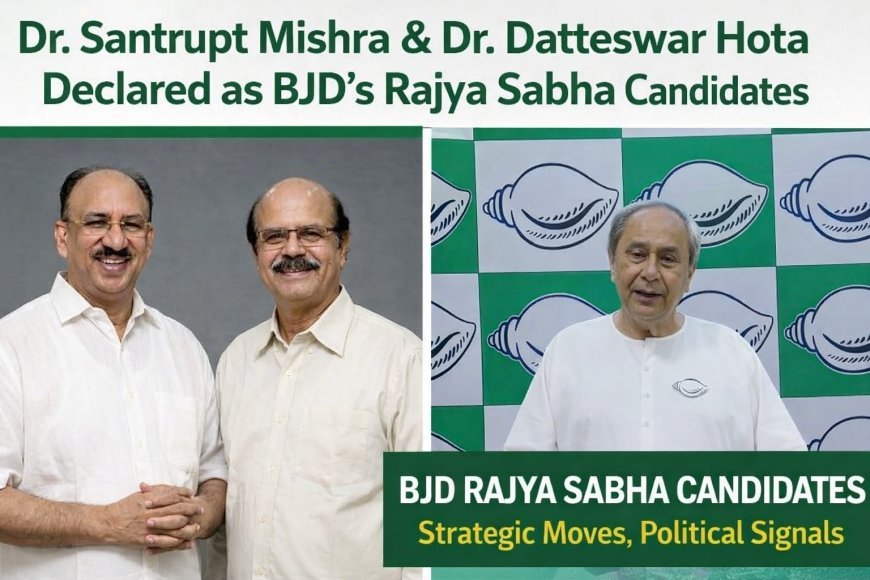
Among the prominent names announced are Dr. Santrupt Mishra and Dr. Datteswar Hota, whose inclusion has generated considerable discussion in political and policy circles. Their professional backgrounds and administrative exposure suggest that the party is leaning toward experience-driven representation in the Rajya Sabha.
A Blend of Experience and Strategy
Dr. Santrupt Mishra, known for his corporate leadership and strategic management acumen, brings a technocratic dimension to parliamentary representation. His exposure to industry, governance systems, and organizational reform may add policy depth to debates on economic growth, labor reforms, and industrial development.
Dr. Datteswar Hota, with his extensive experience in public administration and corporate governance, represents a bridge between institutional knowledge and policymaking. His track record signals the party’s preference for individuals who understand regulatory frameworks, economic policy, and development management.
Under the leadership of Naveen Patnaik, BJD has often balanced political loyalty with professional competence. The nomination of these two individuals appears consistent with that approach—strengthening the party’s voice in Parliament through expertise rather than mere symbolism.
Odisha’s Voice at the Centre
For a regional party rooted in Odisha, Rajya Sabha representation is not only about numbers but about narrative. The Upper House serves as a platform where state-specific issues—mineral policy, disaster management, federal grants, industrial corridors, and welfare implementation—are debated.
By nominating professionals like Dr. Mishra and Dr. Hota, BJD signals that Odisha’s engagement at the Centre may increasingly focus on technical, economic, and governance-oriented arguments rather than rhetorical positioning.
Political Message to the Cadre
While technocratic nominations strengthen intellectual capital, they also carry an internal political message. Party workers often look at Rajya Sabha seats as recognition for grassroots dedication. Therefore, the leadership must balance merit-based selections with organizational morale.
The broader question remains: will these nominations consolidate BJD’s image as a stable, development-focused party, or will they invite fresh debates about representation and internal democracy?
The Road Ahead
The true measure of any Rajya Sabha nomination lies not in announcement but in performance. The citizens of Odisha expect their representatives to articulate regional aspirations while contributing meaningfully to national policy.
If Dr. Santrupt Mishra and Dr. Datteswar Hota leverage their experience effectively, they could enhance Odisha’s parliamentary footprint. If not, the declaration will remain a strategic headline rather than a transformative moment.
In the evolving landscape of Indian federal politics, such decisions are never isolated—they are part of a larger narrative. The coming parliamentary sessions will determine how this chapter unfolds.