
























“In the epics, wars were fought over women and land. In the days to come, we may witness wars over water,” said Subasini Jena •During the supplementary budget discussion of the Panchayati Raj and Drinking Water Department in the Assembly, Basta MLA Subasini Jena raised serious concerns about the growing water crisis.

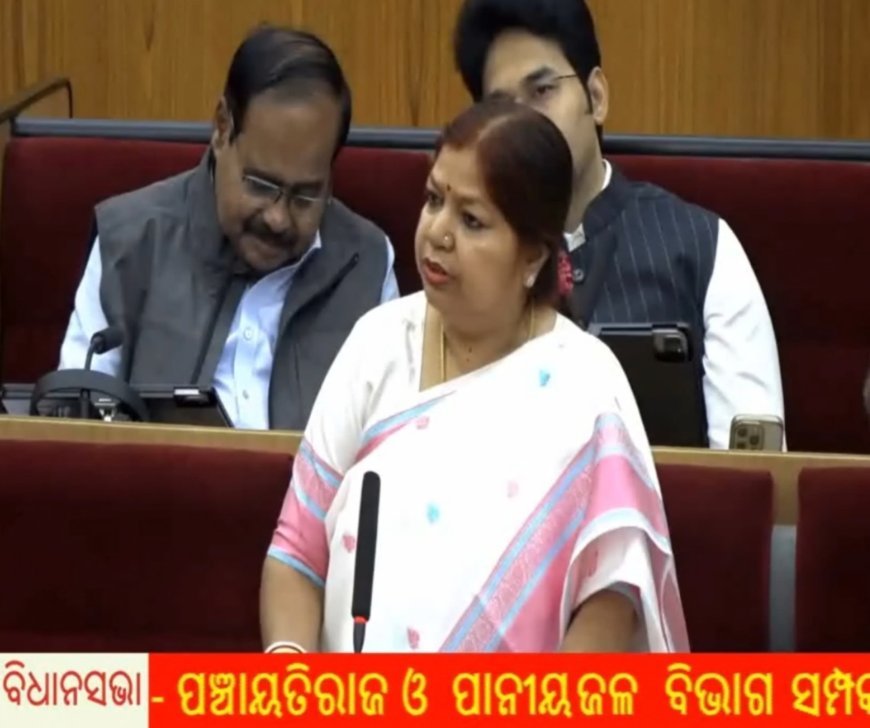
Balasore – 06/12 (Krushna Kumar Mohanty): Speaking in the House last Friday, MLA Subasini Jena warned that if the government does not act immediately, the state may face a situation where conflicts arise over access to water. She reminded the Assembly that in ancient times, the Ramayana and Mahabharata wars were linked to women and land. Today, the alarming scarcity of water demands urgent attention.
Citing various reports, she said nearly 33,000 villages in Odisha are facing acute water shortages, and more than 75 percent of tube wells have recorded a sharp decline in groundwater levels. Many areas have pipelines but no water supply. She highlighted that the mega drinking water project in Baliapal block under the Basta constituency, scheduled for completion in 2023, is still pending.
She also pointed out the deteriorating quality of drinking water. In Patripala panchayat of Remuna block, dangerous fluoride levels have led to widespread dental and skeletal fluorosis, affecting even the younger generation. The drinking water situation is turning critical across India, including Odisha. She noted that while people generally use an ATM to withdraw money, several states now depend on ATMs for drinking water. In Tamil Nadu, water is being transported by trains. If Odisha fails to take firm steps now, a similar situation may not be far away. She urged the government to explain what measures are being taken to address these issues.
Speaking on the Panchayati Raj system, MLA Jena said the institution is linked to thousands of years of Indian history, with references to gram sabhas in the Rig Veda around 1200 BCE. After Independence, Mahatma Gandhi’s vision of Gram Swaraj revived the Panchayati Raj system. On October 2, 1959, then Prime Minister Jawaharlal Nehru formally introduced the modern Panchayati Raj system in India.
She recalled the landmark decision of former Chief Minister Biju Patnaik, who implemented 33 percent reservation for women in the three-tier Panchayati Raj system. Later, former Chief Minister Naveen Patnaik increased this reservation to 50 percent. She noted that to strengthen Panchayati Raj institutions, the government has emphasized Own Source Revenue (OSR) to make panchayats self-reliant. But Odisha’s OSR remains only 11 rupees per capita, compared to Kerala’s 296 rupees and Andhra Pradesh’s 209 rupees. This reflects the fragile economic condition of Odisha’s panchayats.
Citing these issues, MLA Subasini Jena urged the government to address her concerns and ensure adequate provisions in the supplementary budget.