






































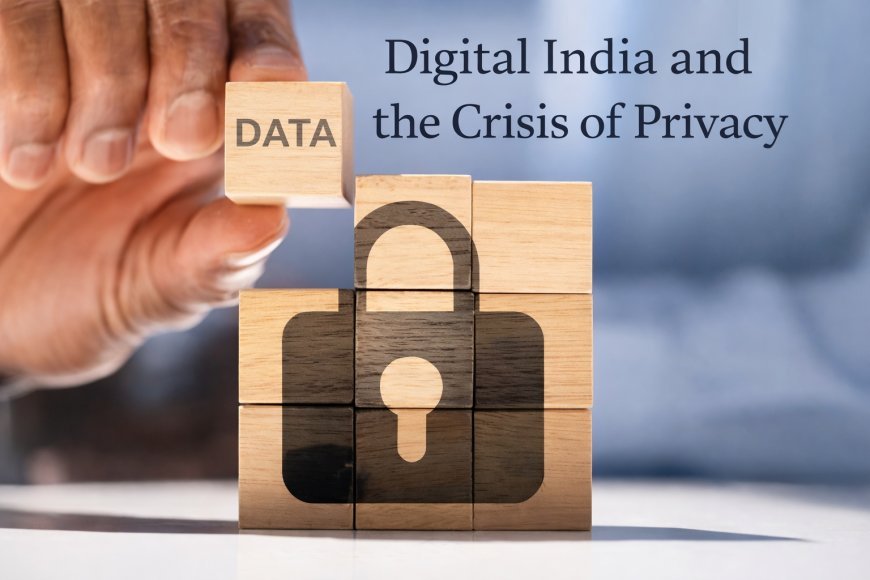
Digital India and the Crisis of Privacy

By : Dr. Sashi Sekhar Samanta
India’s digital transformation is one of the most ambitious projects of the 21st century. From digital payments and online governance to biometric identity systems and data-driven welfare delivery, Digital India has reshaped how citizens interact with the state, markets, and one another. Convenience, speed, and inclusion have become the defining promises of this transformation. Yet beneath this success story lies a growing and deeply unsettling concern—the crisis of privacy.
India’s rapid digitisation has outpaced its ethical and legal preparedness. In the race to modernise, privacy has often been treated as an inconvenience rather than a fundamental right. While technology has expanded access, it has also created unprecedented systems of surveillance, data extraction, and profiling—often without informed consent or adequate safeguards.
The turning point came when the Supreme Court of India, in 2017, recognised privacy as a fundamental right. This landmark judgment acknowledged that dignity, autonomy, and freedom are inseparable from informational self-control. However, recognition alone has not translated into meaningful protection on the ground. The everyday digital experience of Indian citizens suggests a widening gap between constitutional ideals and practical realities.
At the heart of this crisis lies the scale of data collection. Indians now leave digital footprints everywhere—banking transactions, health records, education databases, mobile apps, social media platforms, and biometric systems. Aadhaar, while instrumental in streamlining welfare and identity verification, also exemplifies the risks of centralised data architecture. When vast amounts of personal data are stored, linked, and reused across systems, the potential for misuse—intentional or accidental—multiplies.
Consent, the cornerstone of privacy, has become largely symbolic. Lengthy terms and conditions, opaque data policies, and “take-it-or-leave-it” digital services leave citizens with little real choice. Access to essential services increasingly requires surrendering personal data. In such a scenario, consent is not freely given—it is coerced by necessity.
The private sector’s role in this crisis is equally significant. Data has become the new currency of the digital economy. Indian users are not customers; they are products. Personal behaviour, preferences, locations, and networks are mined, analysed, and monetised. Targeted advertising, algorithmic nudging, and behavioural prediction operate invisibly, shaping choices without awareness. The absence of robust regulation allows corporations to operate in ethical grey zones, where profit consistently outruns accountability.
State surveillance adds another layer of concern. The use of facial recognition technology, monitoring tools, and digital policing—often introduced in the name of security—raises serious questions about proportionality and oversight. Without clear legal boundaries, surveillance risks normalising a culture where citizens are constantly watched, recorded, and evaluated. Democracy weakens when fear replaces trust.
The most vulnerable bear the highest cost. Marginalised communities, lacking digital literacy or legal awareness, are least equipped to challenge misuse of data. Errors in databases can lead to denial of welfare, wrongful exclusion, or harassment, with little recourse. When technology fails, it often fails silently—leaving individuals to prove their existence to the very systems meant to serve them.
India’s long-delayed data protection framework reflects the complexity of the challenge. While legislative efforts are underway, concerns remain about exemptions granted to the state, weak enforcement mechanisms, and insufficient independence of regulatory bodies. A privacy law that prioritises convenience over citizen rights risks becoming a hollow assurance.
The crisis is not technological—it is philosophical. Digital India has been built on efficiency, scale, and control, but not enough on ethics, transparency, and consent. Privacy is often framed as a luxury concern of the elite, irrelevant to a developing nation’s priorities. This argument is deeply flawed. Privacy is not about hiding wrongdoing; it is about preserving agency. Without privacy, freedom of thought, expression, and dissent become fragile.
Rethinking Digital India requires recalibrating its moral compass. Technology must serve citizens, not condition them. Data collection should be minimal, purpose-bound, and accountable. Citizens must have the right to know who holds their data, how it is used, and how it can be corrected or erased. Digital literacy must include privacy literacy—empowering people to understand and assert their rights.
India stands at a crucial digital crossroads. It can either become a model for rights-based digital governance or drift toward a surveillance-driven state where efficiency overrides liberty. The true success of Digital India will not be measured by the number of apps launched or databases linked, but by whether it protects the dignity of its citizens in the digital age.
Privacy is not the enemy of progress. It is its ethical foundation.