




































Celebrating Genius: National Mathematics Day 2025 and the Timeless Legacy of Srinivasa Ramanujan

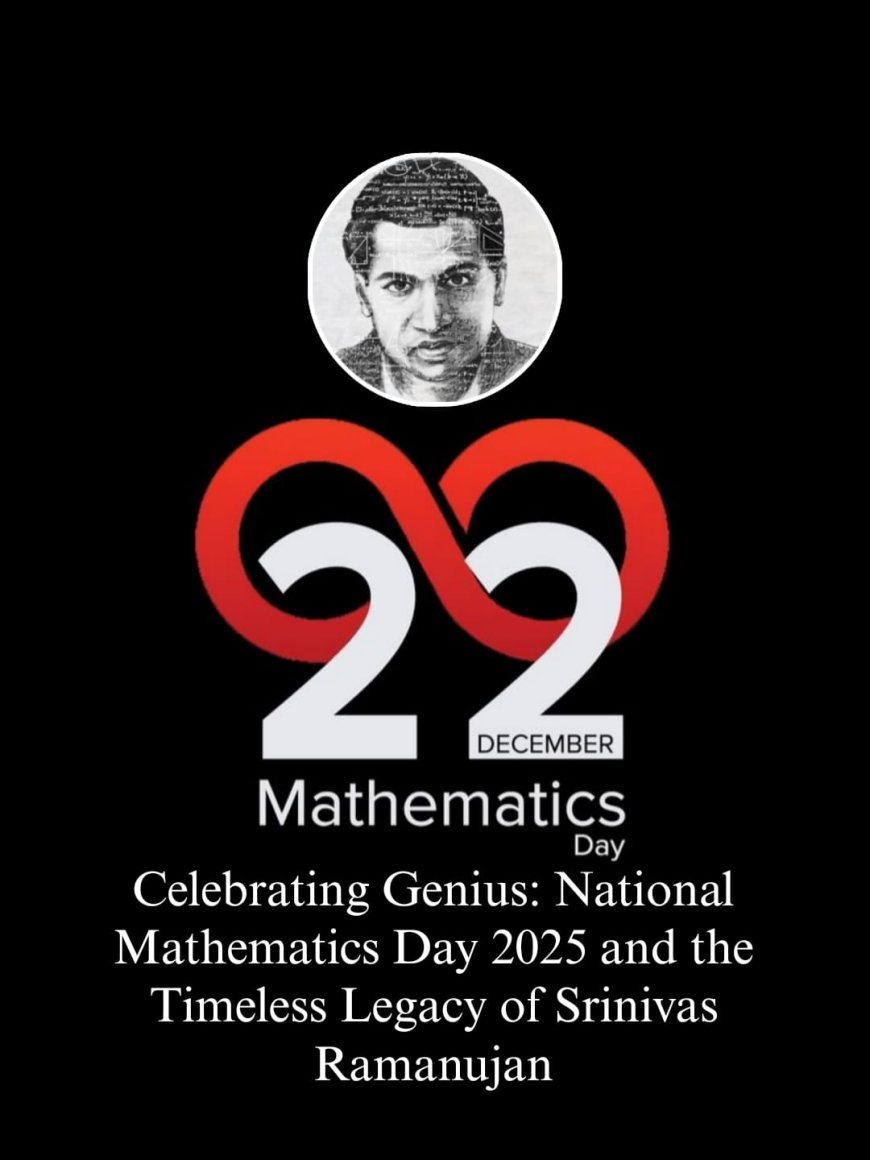
As the winter solstice casts its gentle glow over the Indian subcontinent on December 22, 2025, the nation pauses to honor not just a date on the calendar, but a beacon of intellectual brilliance. National Mathematics Day, observed annually on this day, stands as a tribute to Srinivasa Ramanujan—one of history's most enigmatic and profound mathematicians. In classrooms buzzing with eager students, research halls echoing with scholarly debates, and online forums alive with intellectual fervor, this day unfolds like a symphony of numbers, reminding us of mathematics' pivotal role in unraveling the mysteries of the universe and enriching everyday life.
The Birth of a National Observance
The story of National Mathematics Day begins not in ancient scrolls, but in the corridors of modern governance. In December 2011, the Government of India formally instituted this observance, etching December 22 into the national calendar as a day dedicated to mathematical excellence. This choice was no coincidence; it marks the birth anniversary of Ramanujan, whose life and work embody the spirit of unyielding curiosity and innovation. The following year, 2012, was proclaimed the National Mathematics Year—a nationwide initiative that amplified the push for mathematical education and research, fostering a culture where numbers are not mere symbols, but gateways to discovery.
What makes this day truly significant is its dual purpose: to commemorate a singular genius while igniting a collective passion for mathematics. Across educational institutions, from bustling urban universities to remote rural schools, events unfold with lectures, workshops, and competitions. Research bodies host symposia on cutting-edge theories, and academic forums delve into how mathematics underpins scientific progress—from quantum computing to climate modeling—and permeates the fabric of daily existence, like the algorithms powering our smartphones or the geometry shaping our cities.
Why December 22? A Date Etched in Mathematical Eternity
December 22 is more than a birthday; it is a portal to the extraordinary mind of Srinivasa Ramanujan, born in 1887 in Erode, Tamil Nadu. In an era when formal education was a luxury, Ramanujan rose as a self-taught prodigy, his intellect blooming like a lotus in the mud of adversity. National Mathematics Day celebrates his original thinking—ideas that danced on the edges of intuition and rigor—solving problems deemed insurmountable by his contemporaries. His discoveries in number theory, for instance, continue to ripple through modern mathematics, influencing fields as diverse as string theory in physics and cryptography in cybersecurity.
Official narratives from the Government emphasize that this day transcends mere remembrance. It serves as a vibrant platform to inspire the next generation. Students are encouraged to explore mathematics not as a rote discipline, but as a canvas for creativity, where equations become art and theorems unlock innovations. Researchers, too, find renewed vigor, drawing from Ramanujan's legacy to tackle contemporary challenges in technology and scientific inquiry. In a world increasingly driven by data and algorithms, this observance reminds us that mathematics is the silent architect of progress, weaving threads of logic through the chaos of existence.
India's Ancient Tapestry of Mathematical Wisdom
To fully appreciate Ramanujan's place in history, one must gaze back through the annals of time, where India's mathematical heritage unfurls like an ancient manuscript illuminated by starlight. As noted by the Press Information Bureau, the subcontinent's contributions trace their roots to the Vedic period, spanning from 1200 BCE to 1800 BCE. It was here that foundational pillars of modern mathematics were laid: the decimal number system, which revolutionized counting; the concept of zero, that profound nothingness enabling infinite possibilities; and the elegant dance of negative numbers, expanding the realm of algebra.
The classical and golden eras, from the fourth to the sixteenth century, were a renaissance of intellect. Visionaries like Aryabhatta, who approximated pi and conceptualized the Earth's rotation; Varahamihira, a master of astronomy and trigonometry; Brahmagupta, who formalized rules for zero and negative numbers; and Bhaskara II, whose Lilavati treatise blended poetry with proofs—these scholars transformed mathematics into a harmonious blend of science and philosophy. National Mathematics Day positions Ramanujan within this illustrious lineage, portraying him not as an isolated phenomenon, but as the latest bloom in a garden cultivated over millennia. It invites us to reflect on how these ancient insights continue to echo in today's world, from satellite navigation to financial modeling.
The Enigma of Srinivasa Ramanujan: A Legacy That Defies Time
At the heart of National Mathematics Day lies the mesmerizing tale of Srinivasa Ramanujan himself—a man whose life reads like a mathematical fable. Born into modest circumstances, Ramanujan discovered the beauty of numbers in solitude, compiling nearly 3,900 results through sheer intuition, many of which were groundbreaking. His work in mathematical analysis delved into the depths of functions and series; in number theory, he unraveled partitions and primes; infinite series bent to his will, revealing patterns unseen; and continued fractions unfolded like infinite fractals under his gaze.
What sets Ramanujan apart is his unconventional path. Lacking formal training, he relied on dreams and divine inspiration—famously claiming that the goddess Namagiri whispered theorems to him in slumber. His collaboration with G.H. Hardy at Cambridge University bridged Eastern intuition with Western rigor, producing theorems that still puzzle and inspire. As the PIB highlights, Ramanujan's ideas have opened new vistas in mathematical thought, influencing quantum mechanics, computer science, and even the search for extraterrestrial intelligence through prime number patterns.
Yet, his legacy is not confined to academia. It speaks to the human spirit—the triumph of perseverance over poverty, of creativity over convention. In 2025, as we mark this day amid rapid technological leaps, Ramanujan's story urges us to embrace the unknown, to see beauty in abstraction, and to recognize that genius can emerge from anywhere.
A Call to Embrace the Infinite
As National Mathematics Day 2025 dawns, let it be more than a commemoration; let it be an invitation. To students pondering equations under fluorescent lights, to researchers charting uncharted territories, and to all who marvel at the world's wonders—mathematics is your ally. In honoring Ramanujan, we honor the infinite potential within us all. For in the elegant symmetry of a formula or the profound simplicity of zero lies the key to unlocking tomorrow's innovations. May this day inspire a renaissance of curiosity, where numbers sing and minds soar, perpetuating India's eternal dance with the divine language of the universe.
Sanjay Pattnayak
Sundargarh