










From Verse to Victory: The Life and Legacy of Atal Bihari Vajpayee
(Reflects his journey from poet to transformative leader)

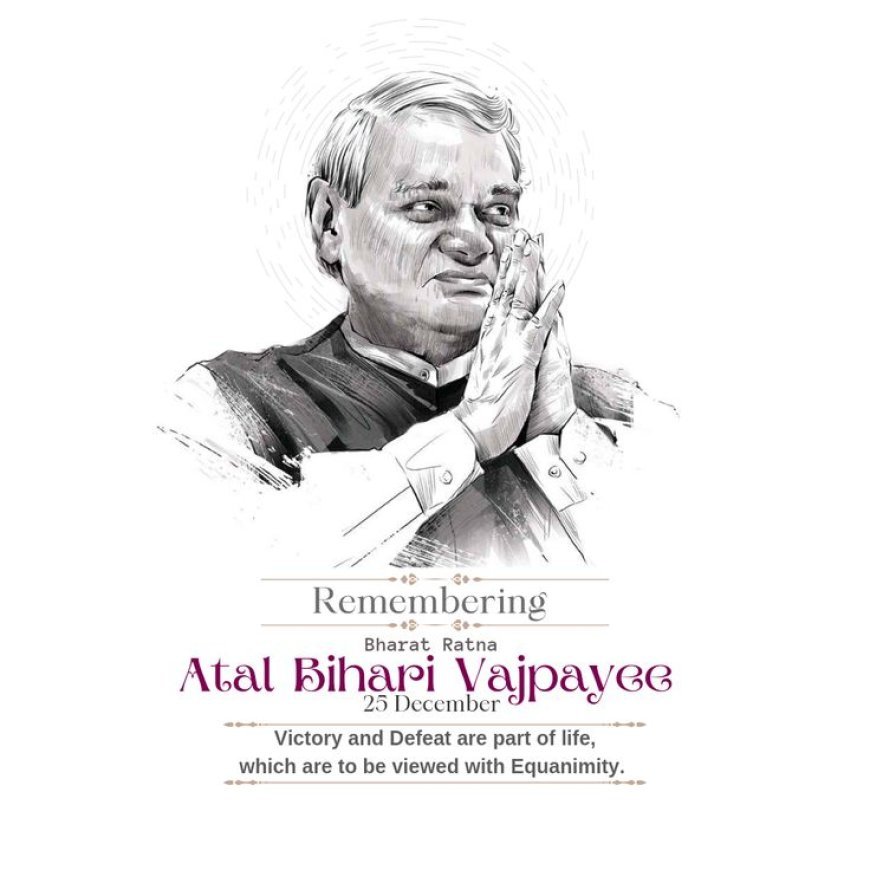
Atal Bihari Vajpayee (25 December 1924 – 16 August 2018) was an Indian statesman, poet, and politician who served as the Prime Minister of India three times: for 13 days in 1996, for 13 months from 1998 to 1999, and for a full term from 1999 to 2004. A co-founder and senior leader of the Bharatiya Janata Party (BJP), he was also a dedicated member of the Rashtriya Swayamsevak Sangh (RSS), blending cultural nationalism with political moderation. Known for his eloquent oratory, Vajpayee's career spanned over five decades in Parliament, where he was elected ten times to the Lok Sabha and twice to the Rajya Sabha. His life exemplified a commitment to India's democratic ethos, earning him the Bharat Ratna, India's highest civilian award, in 2015.
Early Life and Education
Vajpayee was born into a Kanyakubja Brahmin family in Gwalior, then part of British India (now Madhya Pradesh). His father, Krishna Bihari Vajpayee, was a school teacher and poet, while his mother was Krishna Devi. Growing up in a modest household, he attended Saraswati Shishu Mandir for primary education and Gorkhi School for high school. He earned a Bachelor of Arts in Hindi, English, and Sanskrit from Victoria College (now Maharani Laxmi Bai Govt. College of Excellence) in Gwalior. He later completed a Master's degree in political science from DAV College in Kanpur, supported by a scholarship from the Scindia dynasty. Influenced by the RSS from a young age, Vajpayee joined the organization in 1939 as a swayamsevak and became a full-time pracharak in 1947, shaping his worldview around self-discipline, social reform, and national unity.
Political Career
Vajpayee's political journey began in the 1940s with the Arya Kumar Sabha, the youth wing of the Arya Samaj, where he served as general secretary. He worked as a journalist for RSS-affiliated newspapers under Deendayal Upadhyaya. In 1951, he joined the Bharatiya Jana Sangh (BJS), the precursor to the BJP, as national secretary for the northern region. He contested his first Lok Sabha election in 1957 from Mathura but lost, later winning from Balrampur. Rising quickly, he became BJS president after Upadhyaya's death in 1968.
Arrested during the 1975–1977 Emergency under Indira Gandhi, Vajpayee emerged as a key opposition figure. In the post-Emergency Janata Party government, he served as Minister of External Affairs (1977–1979) under Morarji Desai, notably delivering India's first UN General Assembly speech in Hindi. He co-founded the BJP in 1980 and served as its first president until 1986. Under his leadership, the party moderated its stance, though it faced setbacks in the 1984 elections. As Leader of the Opposition from 1993 to 1996, he guided the BJP to become the largest party in 1996, forming a short-lived government. In 1998, he led the National Democratic Alliance (NDA) to power, and after fresh elections in 1999, he completed a full term until 2004, retiring from active politics in 2005 due to health issues.
Contributions to the Nation
Vajpayee's tenure as Prime Minister marked significant advancements in India's strategic, economic, and infrastructural landscape. In 1998, he authorized the Pokhran-II nuclear tests, establishing India as a nuclear power and asserting its sovereignty despite international sanctions, which were lifted within months. Economically, his government pursued liberalization, privatization, and foreign investment, achieving GDP growth exceeding 7% annually from 2003 to 2007, laying the foundation for India's emergence as a global economic player.
In infrastructure, he launched ambitious projects like the National Highways Development Project (including the Golden Quadrilateral connecting major cities), the Pradhan Mantri Gram Sadak Yojana for rural road connectivity, and the Sarva Shiksha Abhiyan to universalize elementary education. His foreign policy emphasized peace and dialogue: the 1999 Lahore Declaration with Pakistan aimed at resolving conflicts, including Kashmir, while the 2001 Agra Summit and a 2003 visit to China improved bilateral ties, with India recognizing Tibet as part of China. He also managed crises like the 1999 Kargil War and the 2001 Parliament attack with restraint, mobilizing troops in Operation Parakram but ultimately withdrawing to de-escalate tensions. These efforts strengthened India's international standing and domestic cohesion.
Vajpayee as a Poet
Beyond politics, Vajpayee was a prolific Hindi poet whose work reflected themes of patriotism, resilience, and moral optimism. He viewed his poetry as a "declaration of war" against despair, embodying the warrior's will to win rather than defeat. He authored several collections, including Kaidi Kaviraj Ki Kundalian (written during his Emergency imprisonment), Amar Aag Hai (1994), Meri Ikyavan Kavitaen (1995, with some poems set to music by Jagjit Singh), Kya Khoya Kya Paya (1999), Twenty-One Poems (2003 English translation), and Chuni Hui Kavitaen (2012). His prose works, such as National Integration (1961) and New Dimensions of India's Foreign Policy (1979), intertwined poetry with political thought. Vajpayee's verses often drew from India's cultural heritage, inspiring generations and appearing in films and media.
Respect Across Political Parties
Vajpayee was universally admired as a statesman who transcended partisan divides, often referred to as the "Bhishma Pitamah" of Indian politics—a Mahabharata figure respected by all sides. Even Jawaharlal Nehru praised his oratory and predicted his future as Prime Minister. Leaders from opposing parties, including Manmohan Singh and Sonia Gandhi, lauded his moderation and coalition-building skills. During the 2002 Gujarat riots, he publicly urged restraint, earning cross-party appreciation. His ability to harmonize Hindu nationalism with democratic pluralism, coupled with his role in uniting opposition against the Emergency, solidified his legacy. Tributes at his state funeral in 2018 came from across the political spectrum, and memorials like the Atal Tunnel and Good Governance Day on his birthday underscore his enduring respect.
Vajpayee passed away in 2018 after a prolonged illness, leaving behind a legacy of visionary leadership, cultural pride, and inclusive governance that continues to influence Indian politics.
Sanjay Pattnayak
Sundargarh