




































*The Bookseller Who Never Locked His Door*


*By Krushna Kumar Mohanty*
*Mohammed Aziz* is often described as the soul of a bookshop rather than merely its owner. Since 1967, he has been running his modest store in the old quarters of Rabat, shaping a life defined not by commerce but by reading.
To step into his shop is to step into another rhythm of time. The place is not arranged for display; it is arranged for discovery. Books rise in tall, uneven stacks. Shelves bend slightly under their weight. Narrow passages demand patience from visitors. There is no hurry here. Dust gathers softly. Light filters in without drama. And somewhere within those quiet towers of paper, Aziz sits reading, as he has done for nearly six decades.
He does not read to pass the time between customers. Reading is his discipline, almost his prayer. Over the years, he has read thousands of books in Arabic, French, Spanish, and English. Each language has widened his horizon. Each book has added another chamber to his inner life. When a young student hesitates at the doorway or a traveller searches for something meaningful, Aziz listens carefully. Then he suggests a title. Not because it is fashionable, but because he knows its depth. He has walked through its pages.
There is something deeply reassuring about a bookseller who knows his books not from catalogues but from memory. His recommendations carry the warmth of personal experience. He remembers characters, arguments, even a particular line that stirred him years ago. In that sense, his shop is not merely a marketplace. It is a silent classroom, a refuge, a living conversation between minds separated by time and geography.
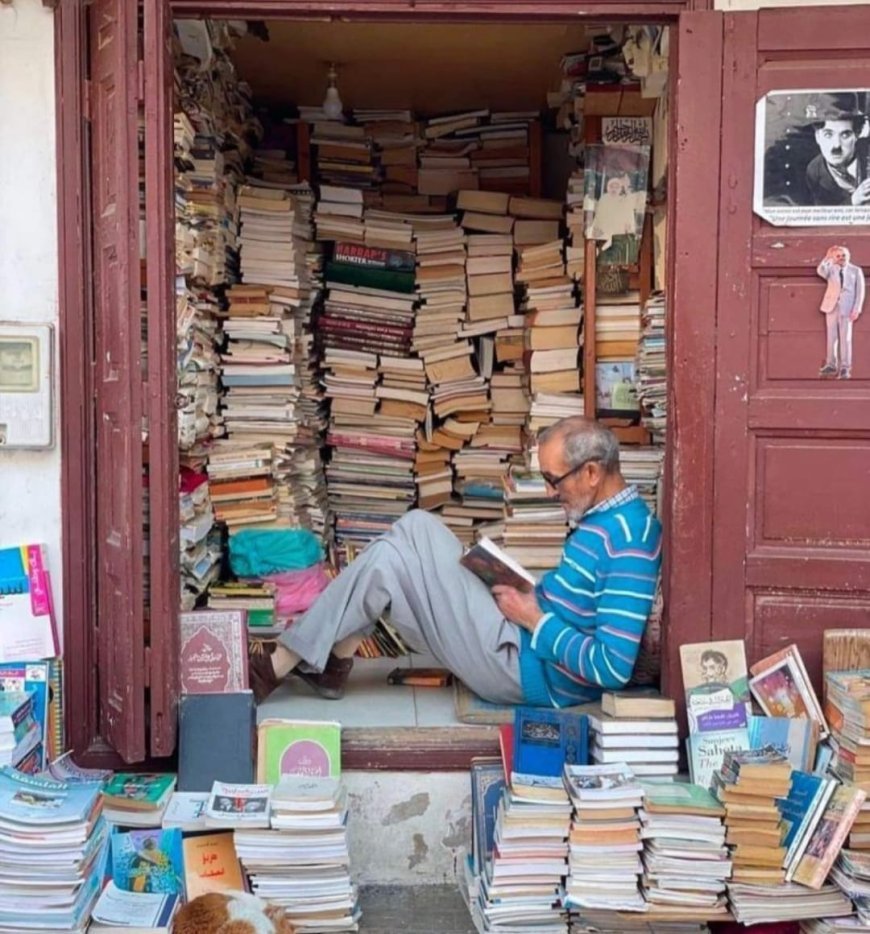
Aziz lives simply. He is known for modest habits and an indifference to comfort. The shop is both his livelihood and his lifelong companion. While others might have expanded, modernised, or turned such a space into a brand, he chose continuity. The store has remained what it always was: a sanctuary for readers. Over time, it has become something of a landmark in Rabat.
Locals, students, visiting writers, and wandering tourists all pass through its narrow aisles. Many leave with more than a purchase. They leave with a memory.
Perhaps the most astonishing detail about his life is that the shop has reportedly never been locked. The doors remain open. In an era ruled by surveillance cameras and alarms, this seems almost improbable. When someone once asked him whether he feared theft, his reply was simple and unforgettable: “Readers don’t steal books, and thieves don’t read books.”
It sounds light at first, almost humorous. Yet beneath it lies a quiet faith in the moral force of reading. Aziz believes that a genuine reader carries a certain respect within. A book, to such a person, is not an object to be stolen but a companion to be earned.
When I think of our own literary climate, especially among Odia readers, this story strikes deeper. We often lament that people no longer read. We say the next generation prefers social media reels to printed pages. We complain that attention spans are shrinking and that books are losing their place in homes. Libraries grow silent. Book discussions struggle for participants. Even serious literary works compete with fleeting digital distractions.
In that atmosphere of concern, Mohammed Aziz stands like a quiet answer. He is not merely an old bookseller in Morocco. He is a living reminder of what it means to anchor one’s life in reading. He proves that books are not outdated objects. They are enduring presences.
We often say that friends may disappoint us, institutions may fail us, and trends may fade. But books remain. They wait patiently. They do not betray. They do not flatter falsely. They challenge, console, provoke, and sustain. In that sense, books are the only friends who never cheat us. Aziz seems to understand this truth instinctively. His open door is not only a gesture of trust toward customers. It is also a sign of trust toward books themselves.
His life teaches us something essential. Reading is not a hobby to be squeezed between distractions. It is a way of shaping the mind and steadying the heart. A society that neglects books risks losing depth. A generation that abandons reading risks losing reflection.
For many of us, owning a bookshop sounds like a dream.
For Mohammed Aziz, it has been a steady, unbroken devotion. Year after year, page after page, he has remained where he began, among his books, with his door open. In his quiet persistence, there is a lesson for all of us: if we wish to preserve the soul of literature, we must first return to the simple act of reading.
*krushna.kk@gmail.com*