


































Odisha at the frontline of ‘Water Bankruptcy’: Gram Vikas launches Governance Led Water Security Model

Bhubaneswar (By Abhishek Mohanty): In early 2026, the United Nations warned that large parts of the world are moving towards “water bankruptcy”, a condition where water demand persistently exceeds the ability of ecosystems and institutions to replenish and govern it. Unlike drought, water bankruptcy reflects long term ecological exhaustion and governance failure.
For rural India, this is no longer a future risk. In Odisha’s hilly and forested districts, drying springs, erratic rainfall, failing piped systems, and declining farm productivity are already visible. With nearly 70% of households dependent on rain-fed agriculture, climate stress is directly threatening livelihoods and food security.
Responding to this reality, Gram Vikas has introduced the Water Secure Gram Panchayat (WSGP) programme, marking a strategic shift from infrastructure delivery to governance led water security. Built on five decades of experience, WSGP strengthens water systems through four pillars: Sustainability, Safety, Prosperity, and Equity & Resilience.
Instead of focusing only on pipes and pumps, WSGP treats the Gram Panchayat as the unit of action.
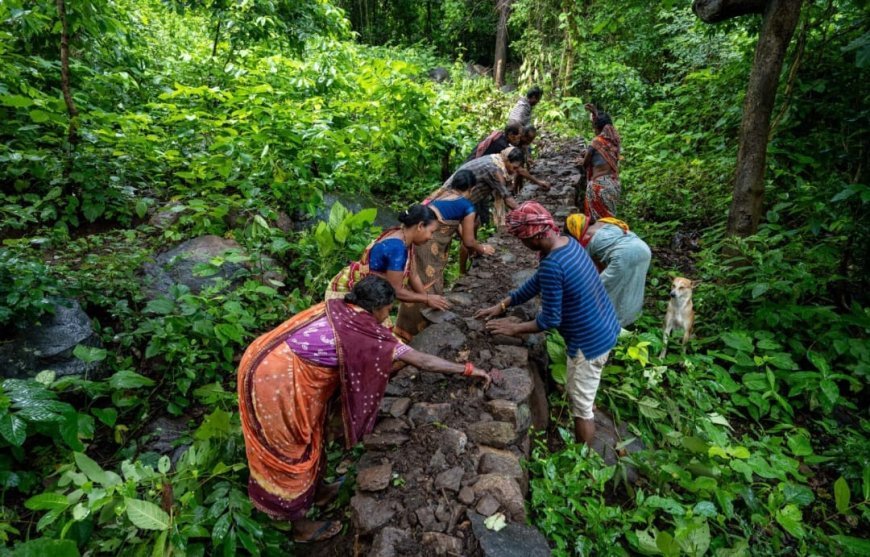
Panchayats lead planning, regulation, and monitoring of local water resources. Through springshed management, aquifer mapping, forest regeneration, and land-use planning, communities restore natural recharge processes rather than relying on deeper extraction.
Safety is strengthened through source protection and community monitoring of water quality. Prosperity is addressed by helping farmers adopt climate resilient practices and optimise water use, linking water reliability with income security. Equity and resilience are embedded by ensuring women, youth, and marginalised households participate in decision-making and benefit from water governance.
Early results are promising. Communities have treated 5,065 hectares of degraded land, reforested 697 hectares, and achieved a 15% increase in water availability in critical sources, recharging nearly two million cubic metres of water. More than 130,000 people now have tap water at home, and nearly 10,000 farming households report higher incomes, with winter farm earnings rising by 33%.
As climate risks intensify, Odisha’s experience shows that water security must be governed, not merely delivered. Empowered Gram Panchayats are emerging as the backbone of long term, climate resilient water stewardship.