




































On the Eve of Saraswati Puja: Honoring the Goddess of Knowledge Through True Enlightenment

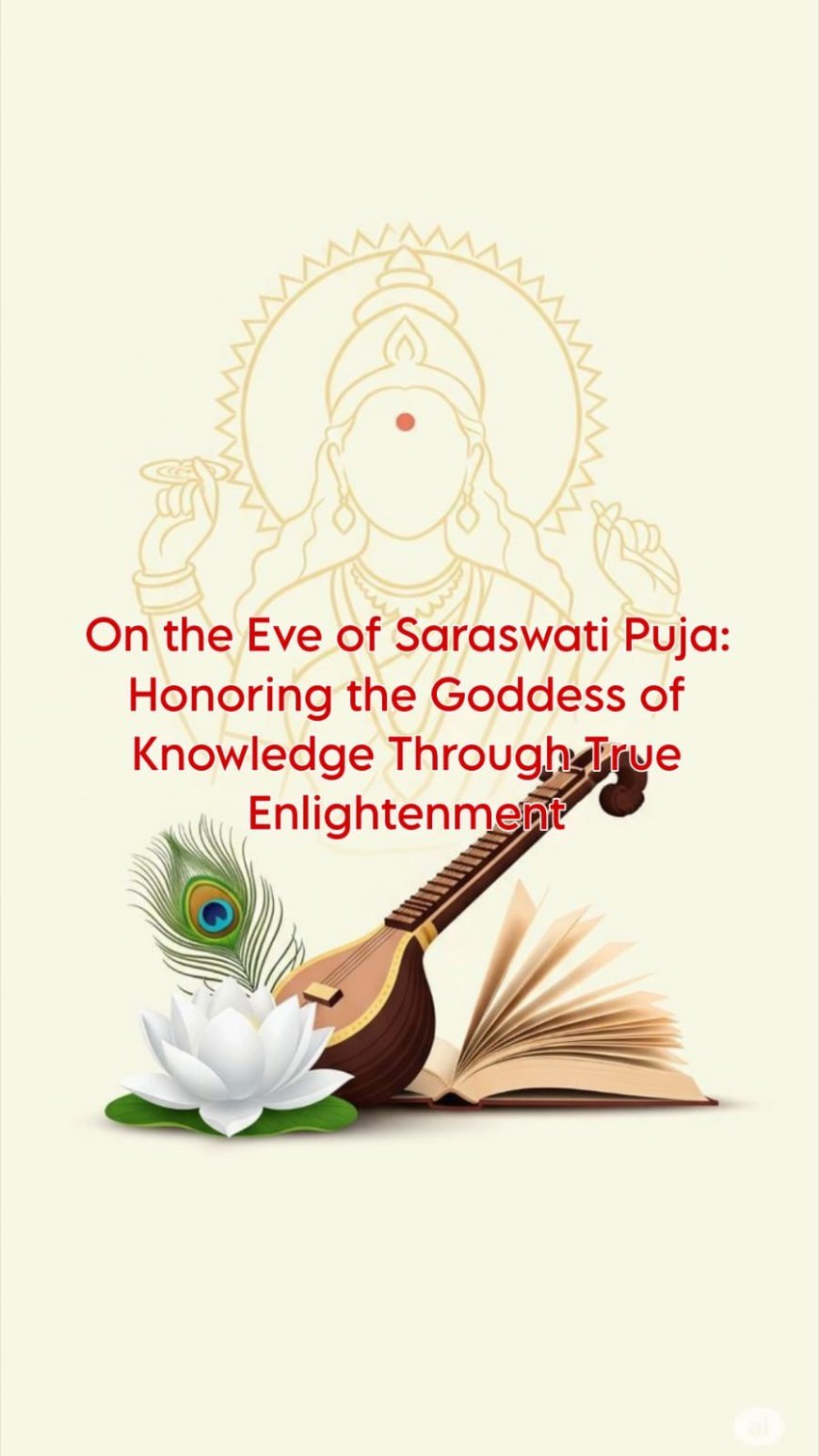
As the gentle hues of dawn prepare to paint the sky on this auspicious eve of Saraswati Puja, homes and temples across India resonate with the soft chants of mantras and the fragrance of fresh flowers. Saraswati Puja, celebrated on Vasant Panchami, marks the arrival of spring and pays homage to Goddess Saraswati—the divine embodiment of knowledge, wisdom, arts, and learning. Clad in white, seated gracefully on a lotus with a veena in her hands, she symbolizes the purity of intellect and the flow of creativity. In Kolkata, where the festival holds special fervor, streets come alive with students placing their books at her feet, seeking blessings for academic success. Yet, as we light incense and offer sweets, a deeper reflection beckons: Are our rituals truly honoring the goddess, or are they mere traditions devoid of their profound significance?
In Hindu mythology, Saraswati is not just a deity to be appeased through offerings; she represents the pursuit of enlightenment that elevates humanity. Her blessings are said to pave the way for prosperity, often personified by her sister, Goddess Laxmi. The ancient texts remind us that knowledge is the foundation of wealth—without wisdom, riches remain fleeting. This interplay between Saraswati and Laxmi is beautifully metaphorical: Invest in education, and prosperity follows. But in modern India, have we internalized this wisdom, or are we content with superficial observances?
Consider the United States, a nation far removed from the cultural rituals of Saraswati Puja, yet one that arguably worships the goddess more devoutly through its actions. The USA has built a robust educational ecosystem that prioritizes innovation, research, and accessibility. According to global assessments, the United States ranks first in overall education quality, boasting a system funded largely through state and local taxes, with compulsory education from ages 5 to 16. This commitment has resulted in seven of the top ten global universities, including Harvard, MIT, and Stanford, as per the Best Global Universities rankings. The QS World University Rankings 2026 further highlights this dominance, with MIT at the pinnacle and multiple American institutions in the top echelons.
This focus on quality education has translated into unparalleled prosperity. The USA's economy thrives on knowledge-driven industries like technology, biotechnology, and finance, attracting global talent and fostering innovation. From Silicon Valley's startups to groundbreaking research in AI and medicine, the fruits of Saraswati's blessings manifest as economic might—echoing the idea that Laxmi follows where knowledge reigns. In 2023 alone, over 61% of high school graduates enrolled in college, underscoring a culture that values lifelong learning. It's no coincidence that the USA leads in patents filed and Nobel laureates produced; their "worship" of Saraswati is pragmatic, yielding tangible wealth and global influence.
In stark contrast, India's approach often seems ritualistic rather than transformative. We celebrate Saraswati Puja with great pomp—students abstain from studies on the day, placing instruments and books before the idol, hoping for divine intervention. But do we question the deeper meaning? The festival's essence lies in nurturing young minds, yet our educational institutions lag far behind global standards. Indian universities, while producing talented graduates through institutions like the IITs and IIMs, do not feature prominently in top global rankings. In the Times Higher Education World University Rankings 2026, no Indian university cracks the top 100, with the highest-ranked ones hovering around the 200-300 range. Globally, India ranks 42nd in education quality, trailing not just the USA but even smaller nations.
This disparity extends beyond universities to foundational education. In international benchmarks like the Programme for International Student Assessment (PISA), India has historically underperformed, opting out in recent years due to concerns over representation. Comparative studies reveal systemic issues: overcrowded classrooms, rote learning over critical thinking, and inadequate teacher training. The National Education Policy (NEP) 2020 aims to address these with emphases on experiential learning and skill development, aligning somewhat with global best practices. Yet, implementation remains a challenge, and the gap persists. We spend about 4.6% of GDP on education, but inefficiencies dilute its impact, leaving millions of young minds underserved.
To illustrate further, let's turn to smaller countries like Singapore and Finland, which punch above their weight in education despite limited resources. Singapore, a city-state with no natural resources, has transformed itself into an economic powerhouse through education. It consistently tops PISA rankings in math, science, and reading, with scores like 543 in reading literacy in 2022—far above the OECD average.The system's "Teach Less, Learn More" policy emphasizes depth over breadth, fostering critical thinking and innovation. Universities like the National University of Singapore (NUS) rank in the global top 10, driving STEM excellence and contributing to Singapore's high GDP per capita. This educational prowess has attracted Laxmi's blessings, making Singapore a hub for finance, technology, and trade.
Finland, on the other hand, exemplifies equity and student well-being. With no standardized testing until age 16 and shorter school days, Finland ranks high in global education indices, often in the top 10 for overall quality. Teachers are highly trained and respected, with master's degrees mandatory, and the system prioritizes personalized learning over competition. Spending about 5.6% of GDP on education, Finland ensures free, inclusive schooling, resulting in high student satisfaction and innovation. Despite its small population, Finland's knowledge economy—bolstered by companies like Nokia—demonstrates how true devotion to Saraswati yields prosperity.
These examples underscore a painful truth for India: We are well behind. Our universities pale in comparison to those in the USA, where research funding and infrastructure create ecosystems of excellence. Even against Singapore and Finland, India's rote-based system stifles creativity, with pupil-teacher ratios and infrastructure woes exacerbating inequalities. We follow traditions like Saraswati Puja faithfully, but without grasping its call to action—building a quality educational framework that nurtures curiosity, innovation, and inclusivity.
On this eve, let us redefine our worship. True homage to Saraswati lies not in fleeting rituals but in systemic reform. Imagine an India where every child accesses world-class education: revamped curricula emphasizing skills over memorization, increased funding to 6% of GDP, and teacher empowerment akin to Finland's model. The NEP 2020 is a step forward, promoting multidisciplinary learning and vocational training, but it demands urgent execution. By emulating the USA's innovation hubs, Singapore's efficiency, and Finland's equity, we can foster generations of thinkers, inventors, and leaders.
When we invest in education this way, Goddess Laxmi will inevitably follow. A skilled workforce drives economic growth, reduces poverty, and positions India as a global leader. Prosperity isn't just material wealth; it's the glory of a nation where knowledge illuminates every corner, banishing ignorance and inequality.
As the lamps flicker and prayers rise this Saraswati Puja, let our resolve be firm: To worship the goddess not merely with flowers and chants, but with actions that enlighten our youth. Only then will India reclaim its ancient legacy as a cradle of wisdom, basking in the dual blessings of Saraswati and Laxmi. May this festival inspire not just devotion, but transformation—for our motherland's brighter tomorrow.
Sanjay Pattnayak
Sundargarh