



































No Vice-Chancellors, No Vision: The Blind Administration of Higher Education in Odisha

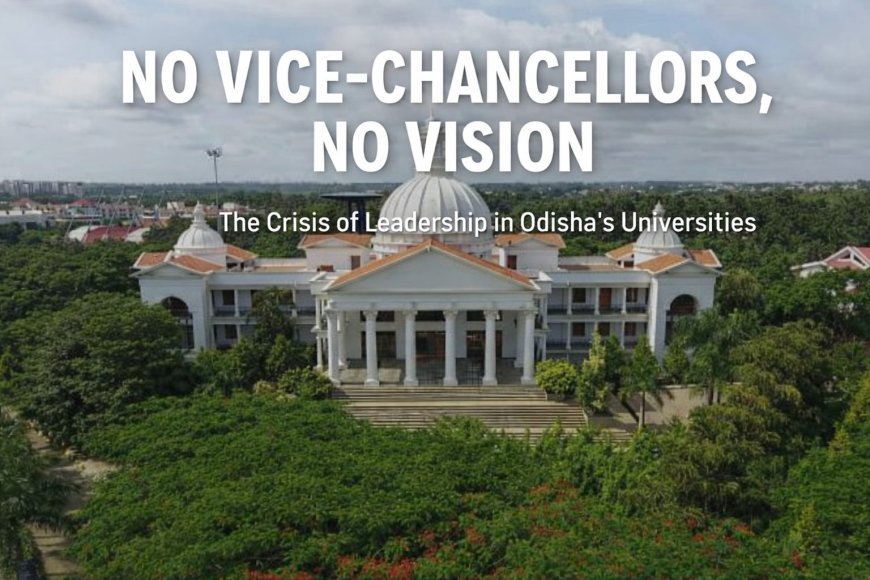
By | Dr. Shashi Sekhar Samanta
Higher education in Odisha is facing an unprecedented administrative vacuum. Months have passed, yet several major state universities continue to function without permanent vice-chancellors. Institutions that shape the intellectual and professional future of thousands of students are operating under temporary arrangements, ad-hoc leadership, and bureaucratic uncertainty.
For a state that aspires to become an educational hub in eastern India, the absence of permanent academic leadership raises serious questions about governance, political priorities, and administrative efficiency.
The situation today reflects not merely a procedural delay but a deeper crisis in the management of higher education.
Universities Without Captains
A university without a vice-chancellor is like a ship without a captain. The vice-chancellor is not just a ceremonial figure; the position represents the academic and administrative head responsible for guiding policy, ensuring academic standards, promoting research, and maintaining institutional stability.
When universities remain without permanent vice-chancellors, several problems arise:
• Academic decisions are delayed
• Recruitment processes slow down
• Research initiatives remain stagnant
• Administrative files accumulate without clear direction
• Long-term institutional planning becomes impossible
Faculty members become uncertain about leadership, and students begin to feel that their institutions are drifting without a clear vision. This is precisely the situation unfolding in many universities across Odisha.
The Political Undercurrent
Behind the administrative paralysis lies a growing political narrative. Observers suggest that the delay in appointing vice-chancellors may be influenced by competing power centers within the political establishment.
On one side is the camp associated with Dharmendra Pradhan,( Union Minister of Education, Government of India ) a prominent national political leader with significant influence in educational policy circles. On the other side stands the state leadership led by CM Mohan Charan Majhi. & Manmohan Samal ( President of BJP Odisha) team.
While there has been no official confirmation of a confrontation, political analysts increasingly describe the situation as an emerging tug-of-war between two administrative approaches. The result of this silent contest appears to be a prolonged delay in critical academic appointments. When political considerations overshadow academic governance, institutions inevitably suffer.
The Cost to Students
The most immediate victims of this administrative stagnation are students. Universities exist primarily to nurture young minds, yet students are now witnessing a system that appears directionless.Several consequences are already visible: Examinations and academic schedules are sometimes disrupted due to leadership uncertainty. Recruitment of faculty members remains delayed in many institutions, leading to shortages in teaching staff. Research projects struggle to gain approvals because key decisions require the authority of a permanent vice-chancellor. For postgraduate and doctoral students, the absence of strong academic leadership can significantly affect research supervision, funding approvals, and institutional collaboration.
When leadership is missing, academic ambition suffers.
Faculty Frustration
The faculty community in Odisha’s universities is equally concerned. Professors and administrators often find themselves working under acting or interim leadership, where major decisions are postponed in anticipation of permanent appointments. Without a stable administrative structure, universities cannot effectively plan academic expansions, new departments, or international collaborations. Faculty morale gradually declines when institutional governance appears uncertain. Academic institutions thrive on intellectual independence and clarity of direction—two elements that are difficult to maintain in prolonged administrative limbo.
Bureaucracy Over Academia
Another disturbing aspect of the current situation is the growing perception that bureaucracy is dominating academic governance. University administration requires an understanding of academic culture, research priorities, and intellectual freedom. However, when bureaucratic procedures become the primary drivers of decision-making, universities risk losing their academic character. The delay in appointing vice-chancellors suggests that procedural complexities and political negotiations may have overtaken the urgency of academic needs.
Education cannot wait for political calculations.
Odisha’s Educational Aspirations
Ironically, Odisha has been steadily expanding its higher education infrastructure. Over the past two decades, the state has witnessed the establishment of several universities, technical institutes, and professional colleges. Bhubaneswar, in particular, has emerged as a significant educational center in eastern India, attracting students from neighboring states. However, infrastructure alone cannot build academic excellence. Universities require visionary leadership capable of fostering research, innovation, and global collaboration. Without strong vice-chancellors, institutions risk becoming administrative shells rather than vibrant centers of knowledge.
The National Context
Across India, universities play a crucial role in shaping economic and social development. Nations that invest in higher education leadership consistently outperform others in innovation and knowledge creation. In this context, Odisha cannot afford prolonged uncertainty in its university governance. States that prioritize academic autonomy and leadership often attract better faculty, international partnerships, and research funding. A delay in appointing vice-chancellors sends an unfortunate signal that higher education may not be receiving the urgency it deserves.
Accountability and Transparency
One of the fundamental principles of academic governance is transparency in appointments. Vice-chancellors must be selected through clear procedures involving search committees, academic evaluation, and merit-based selection. When appointments remain pending for extended periods, it naturally fuels speculation about political interference or administrative indecision. For the sake of institutional credibility, the government must communicate clearly about the reasons behind the delay and provide a timeline for resolving the issue.
Universities should not become arenas of political negotiation.
A Test for the New Government
The current situation also serves as a test for the administrative vision of the state government. Leadership transitions often bring opportunities to redefine governance priorities. Ensuring timely appointments of vice-chancellors would demonstrate a commitment to strengthening higher education and restoring confidence within the academic community.The government must remember that universities are not merely administrative units—they are intellectual ecosystems that shape the future of society. Ignoring their leadership needs risks weakening the very foundation of knowledge and innovation.
The Way Forward
Resolving the current crisis requires immediate action. First, the government must expedite the process of forming search committees and completing the selection process for vice-chancellors. Second, appointments should prioritize academic merit, administrative competence, and visionary leadership.Third, universities should be granted sufficient autonomy to function without excessive bureaucratic interference. Finally, higher education must be treated as a strategic priority rather than an administrative afterthought.
Restoring Vision to the System
The absence of vice-chancellors in Odisha’s universities represents more than a bureaucratic delay—it symbolizes a troubling lapse in educational governance.At a time when knowledge economies are shaping global progress, universities cannot function effectively without strong leadership.The responsibility now lies with the state leadership to restore stability, transparency, and vision to the higher education system. Political debates and administrative rivalries must not overshadow the future of students and scholars.
If Odisha truly wishes to build a knowledge-driven society, the first step is simple yet urgent: give its universities the leadership they deserve.