




























Skill Development Centres to come up at three places in Odisha

Bhubaneswar (By Abhishek Mohanty): The Odisha Cabinet chaired by Chief Minister Mohan Charan Majhi on Friday approved 11 proposals of eight departments.
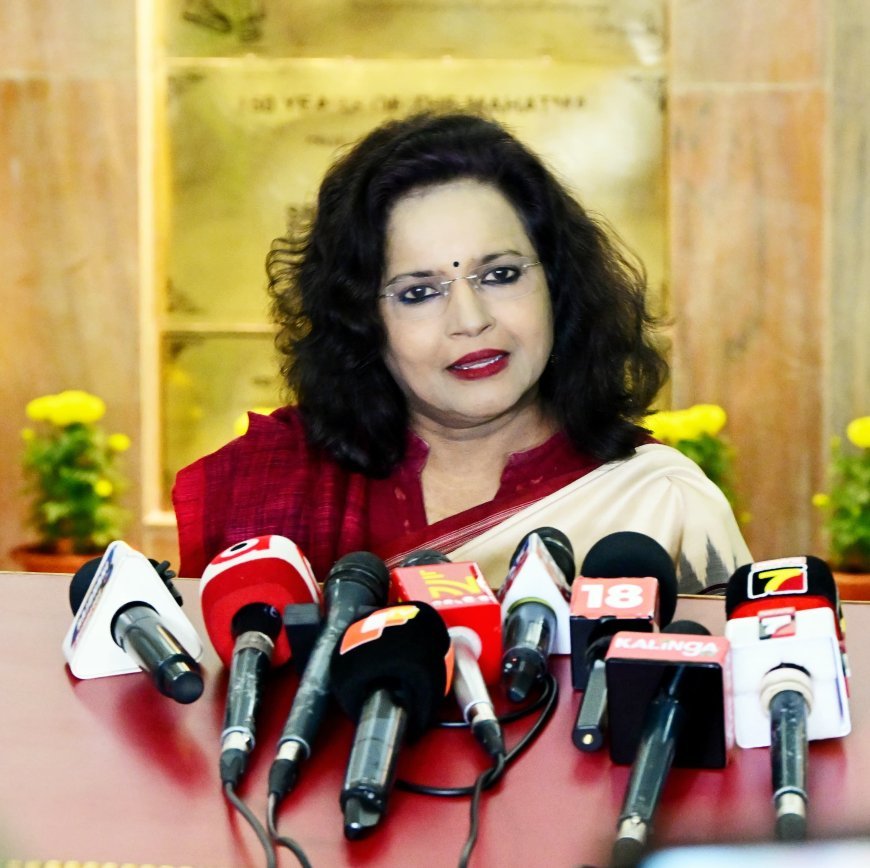
After the meeting, Chief Secretary Anu Garg said, "In a significant step towards building a future-ready and globally competitive workforce, the State Cabinet approved the Odisha Skill Development Project (OSDP) Phase II, a five-year initiative to be implemented from 2025-26 to 2029-30 with assistance from the Asian Development Bank (ADB).
The project aims to strengthen and modernise Odisha's skill development ecosystem in line with Odisha Vision 2036 and 2047, positioning the state as a leading hub for advanced, industry-aligned skilling. The OSDP Phase II builds on the strong foundation laid under Phase 1 (2019-2024), which led to the establishment of the World Skill Conter (WSC), international benchmarking of training programmes, leadership development of faculty, and improved performance in national and international skill competitions. The next phase will focus on expanding advanced skilling Infrastructure, deepening industry linkages, and ensuring wider access to future-ready skills."
The project involves expansion of the existing World Skill Center at Bhubaneswar with now courses in logistics, digital animation, and healthcare, along with the establishment of three new campuses Including Campus II at Bhubaneswar for semiconductor, IT/ITES, and aerospace sectors; Campus III at Berhampur for hospitality and marine sectors; and Campus IV at Sambalpur for agri-tech, renewable energy, retail, and visual merchandising. In parallel, five Government ITIs will be upgraded as Utkarsh ITIs with enhanced Intake capacity, introduction of new-age trades, and strong industry partnerships, supported by a structured roadmap for strengthening all 72 Government ITIs across the state.
To ensure global standards and quality, reputed knowledge partners such as ITEES Singapore will be engaged for mutually agreed courses, bringing internationally benchmarked expertise in curriculum design, assessment systems, faculty development, and institutional transformation. Strong emphasis will be placed on industry partnerships and Industry-recognised certifications to enhance employability, career progression, and global mobility.
Once fully operational, OSDP Phase II is expected to benefit over 60,000 yuuth annually, with special focus on increasing participation of girls, SC/ST communities, Divyangjan, and Particularly Vulnerable Tribal Groups.
The total approved outlay for the project is 1,140 crore, to be implemented over five years through a 50:50 funding anangement comprising 570 crore as loan assistance from ADB and 570 crore from the State Budget.
The state government has proposed to amend the Odisha State Prosecution Service Rules, 1997 (OSPS Rules) to bring them in conformity with the provisions of the Bharatiya Nagarik Suraksha Sanhita (HNSS), 2023. The BNSS, 2023, which came into force on July 1, 2024, under Section 20 provides for a Directorate of Prosecution in every district and a District Directorate of Prosecution in every district, outlining a structured hierarchy headed by a Director of Prosecution and supported by Deputy and Assistant Directors at the district level.
In Odisha, while a Directorate of Public Prosecutions exists at the State level, the present Rulos do not provide for District Directorates. Accordingly, to align with the BNSS, 2023 and strengthen the prosecution framework, the state government has decided to amend the OSPS Rules, 1997.
The proposal has got the approval of the Cabinet.
The Cabinet approved an integrated ingot-wafer and solar cell manufacturing project by Tata Power Renewable Energy Limited (TPREL) at the Tata Special Economic Zone (SEZ) in Odisha. Envisaged as a first-of-its-kind upstream solar manufacturing facility in the state, it will cover the value chain from ingot and wafer to solar cell manufacturing.
The project will be developed in two phases with an overall capacity of 10 GW ingot-wafer and 5 GW solar cell manufacturing. With an investment of about Rs 10,000 crore, it is expected to generate over 5,000 direct and indirect employment opportunities, including a significant share of high-skill jobs, and catalyze downstream and ancillary investments in the renewable energy manufacturing ecosystem.
The facility is expected to strengthen the upstream solar value chain in Odisha, reduce dependence on imports of critical solar components, and support India's target of achieving 100 GW domestic solar module manufacturing capacity by 2030. It will also stimulate ancillary Micro, Small and Medium Enterprises (MSMEs) in areas such as glass, chemicals, packaging, logistics and precision machinery, while enhancing tax revenues.
With Tata Power already operating large-scale solar cell and module manufacturing facilities in India, the project reflects strong investor confidence in Odisha's industrial infrastructure, policy stability and facilitation framework. The project aligns with the state's vision for green Industrialization, high-technology manufacturing and industrial diversification, positioning Odisha as a leading hub for renewable energy equipment manufacturing in India.
The State Cabinet has approved a proposal allowing the Government of Odisha to release the Central share under the Jal Jeevan Mission (JJM) from State funds, in anticipation of reimbursement by the Government of India in order to maintain unabated fund flow for the ongoing projects under JJM.
The proposed fall back mechanism for advance release of Central share by the state is essential to ensure continuity of construction and commissioning activities, prevent demobilisation of agencies and contractors, protect substantial public investment already committed, avoid avoidable escalation of project costs, maintain progress towards Har Ghar Jal certification targets, uphold the credibility of the state's implementation framework.
This measure is an interim financial arrangement, intended to bridge the timing gap between expenditure and receipt of Central share.
The Odisha Apartment (Ownership and Management) Act, 2023, mandates transfer of entire Common Areas and Facilities in favour of Association of Allottees at the time of registration first deed of conveyance. For this purpose, the Association of Allottees was required to pay 5% stamp duty for execution of the deed of conveyance, which resulted in a significant financial burden on apartment owners and created impediments in the process of apartment registration. In order to simplify the registration process, the state government has inserted a new Clause-D under Article-23 of Schedule-I-A of the Indian Stamp Act, 1899. As a result, for registration of the common areas and facilities, the Association of Allottees is now required to pay only a nominal stamp duty of 50,000 for execution of the deed of conveyance. Further at the time of transfer of individual apartment unit, 5% stamp duty pertaining to individual apartment unit along with the undivided proportionate share in the common areas and facilities shall be collected during execution of individual deeds of conveyance in favour of the allottees.
The Integrated Anandpur Barrage Project is a major irigation project in which the construction of Anandpur Barrage on the Baitarani River and its distribution system aims to provide irrigation facilities to 60000 Ha.of CCA in Keonjhar and Balasore districts. Under this project, the construction of the barrage, strengthening of the Salandi river system, and distribution system of 3000 Ha.of CCA through the open canal system have been completed. The distribution system in balance 57,000 Ha, which was originally designed as open flow canals, has now been denided to ba taken up through underground pipeline (gravity flow) system to overcoma delay in land acquisition process. The balance distribution system of Anandapur Barrage Project in 57,000 Ha. Command area has been divided into nine(9) packages and the present proposal "Construction of distribution system for 12155.80 Ha. of CCA including Command Area Dovelopment (CAD) of Salandi Left Main Canal (SLMC) from RD 45.570 km to 49.810 km through Under Ground Pipe Line Irigation system (Gravity Flow) of Anandapur Barrage Project in Balasore District of Odisha on EPC-Turn Key Basis including operation and maintenance of the commissioned project for five years is one of those 9 packages.
Besides, the Cabinet approved the tender for the above work with an execution cost amounting to Rupees three hundred ten crore forty one lakh ninety five thousand nine hundred nine) only (excluding GST) and Operation & Maintenance (O&M) cost for five years amounting to Rupees fifteen crore eighty three lakh thirteen thousand nine hundred ninety one) only (excluding GST). The project is planned to be completed within 27 calendar months.
After complation, this project will provide imigation facilities to 12155.80 hectares of agricultural land in Soro, Bahanaga and Oupada blocks of Balasore District. Apart from this, the project on completion will improve socio-economic condition of people.
The "Parbati Giri Mega Lift Irrigation Scheme" was formulated with an outlay of Rs.10,759.20 Cr to provide supplemental kharif irrigation in the upland ayacut of about 2,63,801 Ha. across the State by lifting available surplus water from rivers/reservoirs and canals which couldn't be irrigated earlier through normal mode of flow irrigation due to its geographical positioning.
The present work is proposed for execution of 6 Lift Irrigation Schemes in Cluster No. XXXI with an objective to create an additional irrigation potential of about 6,343 Ha, in the district of Ganjam by lifting water from Rushikulya River, Ramanadi River, Jira Nalla & Rushikulya River (Near ISS Singipur) through intake system and subsequent flow through pressurized distribution system along with operation & maintenance of complete commissioned schemes for fifteen years.
The Odisha Public Distribution System (Control) Order 2016 was notified during March 2016 for smooth functioning of Public Distribution System (PDS) as per the provision contained under section-3 of the Essential Commodities Act, 1955. All PDS related activities in the State are carried out as per the provisions of the OPDS (Control) Order, 2016.
This Amendment Order is proposed to comply with the directions of the High Court of Orissa to address misuse of PDS benefits drawn in the names of deceased ration card holders. The amendment fixes the responsibility on the Head of Household/authorized member to report deaths for immediate deletion from the RCMS database and provides for recovery in cases of suppression of facts relating to death of any family member(s) in the ration card. It aims to prevent fraud, ensure database accuracy, and safeguard public resources.
The present amendment brings necessary provisions in the OPDS (Control) Order, 2016 by way of amendment in the Ration Card Management System under Clause 27(1) of the Control Order, 2016 by fixing responsibility on the Head of the Household owning the ration card or Nominee of the ration card holder to inform the FPS Licensee and/or concerned Officer of the state government regarding the deceased person(s) in the ration card. In case of failure to do so and receiving the PDS commodities illegally by suppressing such fact, the cost of the PDS commodities so received in the name of the dead person, from the date of death of the person in the ration card, shall be recovered from the concerned family, @1.5 times by deducting the same from the subsequent month(s)' entitlement or, in shape of cost recovery at prevailing Economic Cost. In case of Nominee receiving PDS commodities on behalf of such dead beneficiary(s), if she/he is not a beneficiary and her/his name is not in the ration card, only cost recovery shall be made from the Nominee at prevailing Economic Cost, on quantity of PDS commodities
The Cabinet has also approved the Odisha Tourism (Amendment) Policy-2026, a major reform initiative aimed at strengthening Odisha's tourism sector and aligning it with the State's Vision- 2036 and 2047. The amendments build upon the Odisha Tourism Policy-2022 and seek to enhance investment competitiveness among states, promote sustainable and experiential tourism, encourage private sector participation, and ensure balanced regional development across the state.
To improve ease of doing business and attract a wider range of investors, the Cabinet has approved a reduction in the minimum investment threshold for 3-Star and above hotels and resorts from 50 keys to 10 keys, in line with the norms of the Ministry of Tourism, Government of India. Expansion norms for existing tourism units have also been rationalised by reducing the eligibility threshold from 50% to 25% of existing capacity, enabling easier and faster expansion of operational units.
The Capital Investment Subsidy (CIS) framework has been rationalised into two clear slabs to provide stronger and more predictable support to investors. Tourism projects will be eligible for CIS at 30%, capped at INR 50 crore for investments up to INR 200 crore and INR 100 crore for investments above INR 200 crore.
The Cabinet has also approved the expansion of Special Zones to include high-potential tourist destinations such as Hirakud, Satkosia, Similipal, Ratnagiri-Udayagiri-Lalitgiri and Bhitarkanika, in addition to the existing special zones of Chilika, KBK, Kandhamala and Gajapati. Tourism projects located in these Special Zones, as well as projects promoted by Women, Scheduled Castes, Scheduled Tribes and Differently Abled entrepreneurs, will be eligible for enhanced Capital Investment Subsidy at the rate of 40%, subject to a ceiling of INR 60 crore for projects with investment up to INR 200 crore and INR 120 crore for projects with investment exceeding INR 200 crore.