
































When Classrooms Become Factories: A Radical Critique of Education Collapse in Odisha



By: vikram keshari jena
Director, CARD, Odisha
The crisis in education that many citizens of Odisha feel today is not merely about teachers, salaries, degrees, or governments; it is about the slow erosion of moral imagination. There was a time when teaching in Odisha, as in many parts of India, was less a profession and more a vocation. Teachers carried within them a sense of tapasya a disciplined devotion to shaping young minds. Material scarcity did not prevent intellectual abundance. Many of them worked with modest salaries, large families, and limited infrastructure, yet they possessed a clarity of purpose: education was a sacred social contract. Today, the paradox is unsettling. Financial security has improved for many teachers, family burdens have reduced, access to resources has expanded yet the passion, depth, and ethical seriousness that once animated classrooms often feel diminished. This is not a condemnation of all contemporary teachers, but a reflection on a cultural shift where education risks becoming transactional rather than transformational.
At the heart of this shift lies a deeper philosophical tension between profession and vocation. When teaching becomes primarily a means of economic mobility rather than a commitment to intellectual stewardship, its moral center weakens. A teacher is not merely a conveyor of curriculum but a cultivator of conscience. In Odisha, as elsewhere, the expansion of B.Ed. institutions including the influx of degrees from neighboring states like Andhra Pradesh reflects both aspiration and systemic inadequacy. The demand for credentials has outpaced the cultivation of pedagogical excellence. Degrees have multiplied; mentorship has not. Certification has expanded; methodical training rooted in local context has not always kept pace. The result is a technocratic shell without philosophical substance. Methodology, child psychology, and contextual pedagogy require more than compliance with regulatory norms they require reflective practitioners who understand that education is the slow shaping of character, not the rapid delivery of information.
But the critique must go deeper and more radical. The system itself has normalized mediocrity. Teacher recruitment in many cases has become a bureaucratic ritual rather than a search for intellectual leadership. Entrance tests measure memory, not moral maturity. Interviews often reward conformity, not creativity. Promotions reward seniority, not scholarship. In such an ecosystem, the inspired teacher becomes an exception rather than the norm. The state speaks the language of “learning outcomes” and “skill development,” yet rarely interrogates whether schools are nurturing independent thinkers capable of questioning authority including the authority of the state itself. When education avoids dissent and discourages debate, it ceases to be education; it becomes conditioning. A silent classroom may be efficient, but it is rarely enlightened.
Public policy must therefore be interrogated not with anger alone, but with disciplined critical thinking. The role of the state whether under past administrations or present ones cannot be limited to expanding infrastructure or approving colleges. Policy must ask: what kind of citizen are we trying to nurture? If the answer is merely employable individuals, then schooling will become factory-like. If the answer is ethical, thoughtful, and socially responsible human beings, then teacher training must be rigorous, reflective, and locally grounded. Opening B.Ed. colleges in major districts of Odisha is not inherently a solution unless those institutions embody pedagogical research, supervised internships, community engagement, and continuous evaluation. Quantity without quality becomes a silent sabotage. Regulatory bodies must ensure that teacher education is not reduced to a bureaucratic checkbox but remains an intellectual apprenticeship.

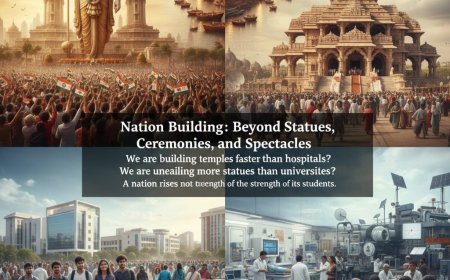
Yet even this critique may be insufficient unless we confront the uncomfortable truth: education policy in India often mirrors electoral cycles more than civilizational vision. Schemes are announced with publicity; reforms are measured in press conferences. Smart classrooms are inaugurated while foundational literacy struggles quietly in rural belts. Tablets are distributed while teacher vacancies remain unfilled. The optics of reform overshadow the substance of reform. When governance prioritizes visibility over viability, children become statistics in annual reports rather than souls in need of guidance. This is not merely administrative inefficiency; it is ethical negligence.
The anxiety about “factory schooling” and the parental obsession with marks the so-called 90% phobia reveals another layer of the crisis. Parents, driven by economic insecurity and social comparison, equate academic scores with survival. Schools respond by mechanizing learning. Coaching centers proliferate like parallel governments of anxiety. Children become carriers of expectation rather than explorers of curiosity. In this ecosystem, teachers too are pressured to produce measurable outcomes rather than meaningful growth. The tragedy is that education becomes competitive performance rather than cooperative inquiry. Odisha, with its rich cultural heritage, literary traditions, and philosophical legacy, risks raising generations who can recite formulas but cannot question injustice, who can clear examinations but cannot navigate ethical dilemmas. When curiosity is sacrificed at the altar of comparison, society produces achievers without awareness.
The criticism of leadership whether bureaucrats, IAS officers, or politicians reflects public frustration with governance that appears disconnected from classroom realities. Formal degrees alone neither guarantee nor deny wisdom. The deeper concern is whether policymakers possess educational imagination. Do they consult classroom teachers before drafting reforms? Do they encourage academic freedom in universities? Do they create platforms for students to participate in shaping their own learning environment? A visionary policy must recognize that education reform cannot be episodic or electoral; it must be generational. The children entering primary school today will shape Odisha’s economy, culture, and democracy in 2045 and beyond. Policy without foresight becomes populism; leadership without listening becomes authority without legitimacy.
Equally important is the ethical dimension of teachership. When allegations arise about violations of moral norms or professional boundaries, society’s trust erodes rapidly. The teacher’s authority rests not merely on knowledge but on integrity. Professional codes of conduct, transparent grievance mechanisms, and community accountability must be strengthened. But radical criticism must also acknowledge systemic hypocrisy: society demands saint-like morality from teachers while often denying them dignity, autonomy, and intellectual freedom. Ethical reform cannot be selective; it must be structural. Accountability must apply to administrators, politicians, and private school owners as much as to classroom teachers.
Philosophically, education is the bridge between memory and possibility. A society that forgets the moral seriousness of teaching risks intellectual decay. Yet despair is not a policy. Critical thinking demands that we separate structural failures from individual shortcomings. It asks us to examine curriculum relevance, teacher recruitment processes, political interference, budget allocation, and societal attitudes simultaneously. It also invites parents to introspect: do we model curiosity at home? Do we equate success only with government jobs or engineering seats? Do we allow children to pursue humanities, arts, or vocational skills with dignity? Reform without self-reflection becomes rhetoric.
If a generation feels it is “going to die with a funeral due to absence of vision,” then the antidote is collective awakening, not fatalism. Civil society forums, teacher unions, academic researchers, and policymakers must collaborate with honesty rather than defensiveness. District-level teacher training institutes should emphasize reflective pedagogy and local language instruction. Digital tools must supplement, not replace, human mentorship. Evaluation systems should reward innovation, research, and ethical conduct rather than mere compliance. Above all, education must be reclaimed as a moral enterprise one that prepares young people not only to compete in global markets but to question injustice, to defend truth, and to act with courage.
The radical truth is this: if classrooms continue to function as examination factories and policy continues to prioritize optics over ethics, Odisha risks producing a generation that is literate but not enlightened, skilled but not wise, ambitious but not humane. The future will not forgive complacency. Education must be rescued from mediocrity by moral courage, intellectual rigor, and uncompromising integrity. The challenge is immense, but so is the responsibility.