































Praharaj Satyanaryana Nanda: Poet of the Earth, and of the Ether



Dr Srimoy DasAdhikary
Former Principal Fakir Mohan College
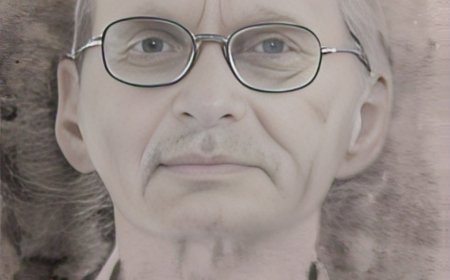
Praharaj Satynarayana Nanda is a standalone poet and a reclusive author in modern Odia lterature Although he worked across severel literary forms-as a poet, short-story writer, journalist, editor, and translator-he did not cultivate-sustained public literary visibility, As a result, much of his work has remained unevenly circulated, His shert-stories, journalistic writings, and editorials have not been systematically anthologized, and except for his translations of Jayadeva's Gite Gobinda and his own poetic work Hiranyaena Sabita Rathena (Sun in the Golden Chariot), most of his transiations remain scattered. His monograph on Ananta Pattanayak is currently unavailable, While he wrote in multiple genres, Nanda is known today primarily as a poet, having written prolifically and leaving behind sixteen volumes of poetry.
Nanda entered the Odia poetry circuit in the 1950s, consolidating his poetic voice in the 1960s, a period when Odia poetry was undergoing a gradual transition from its romantic-nationalist inheritance towards a modernist sensibility. Poets such as Radhanath Ray, Madhusudan Rao, Godabarish mishra, and the early Sachidananda Routray had forged a tradition marked by lyricism, musicality, and a strong nationalist and reformist impulse. Their poetry carried the vigor and idealism of the nationalist movement and addressed a public sphere in which the poet functioned as an identifiable ethical voice of the generation.
With the waning of nationalist idealism in the post-independence years, this romantic mood vielded to a growing sense of disillusionment and fragmentation. The experience of urbanization and displacement introduced doubt and anxiety into public imagination, casting a shadow over earlier visions of collective social harmony. At the same time, the influence of modernist experiments in Anglo-American poetry began to register in Odia literature, shaping the work of poets such as Guruprasad Mohanty, Bhanuji Rao, Ramnakanta Rath, and the later Sachidananda Routray, As the symbolic density of their poetry increased, attention shifted to the inner life of the modern human being--often solitary and uncertain-allowing irony to replace affirmation and introspection to displace public address.
Nanda inhabited this transitional space without inheriting either the romantic-nationalist legacy or the modernist replacement. His English education kept him attuned to developments in Anglo-American poetry, particularly the influence of figures such as T. S. Eliot, without committing him to a programmatic modernism. In this sense, he may be described as modern without being overtly modernist. He did not speak from what might be called the most self-conscious point of his age, nor did he assume the role of a public poet of social intervention. Instead, his poetry turned inward, engaging in a tentative and probing exploration of the human mind, surrounded by sensory details that point towards an underlying, and often quietly held, metaphysical presence.
Nanda's poetry is deeply involved with the elementals--the mountains, the sky, the rivers, and the sea His poetic world has a seamless movement across thresholds: between the earthly and the etheric, the sensory and the metaphysical, the personal and the cosmic. A contrapuntal music runs through his poetry. On the one hand, his poetry leans outward towards nature and towards an immanent divine presence permeating the world; on the other, it moves inward, toward an increasingly refined self awareness. These two movements are inseparable. Nature becomes the mirror of the self, and the self becomes the organ through which the divine is perceived.
At times the poet seems wholly arrested by the earth and by the beauty it offers-recalling Wordsworth's moment of stillness in "Earth has not anything to show more fair", where the world seems complete in its sensuous perfection Yet, unlike Wordsworth's serene poise in the sufficiency of the seen, Nanda does not rest in the fullness of appearance Sensuous ecstasy in his poetry functions as a trigger rather than as a terminus: it impels the poet into the complex crochet of the mind, opening an aperture into a higher, epiphanes realm that remains suggestive rather than declared.
A key structural feature of Nanda's poetry is the presence of a mystical feminine figure--an implied woman who is not a literal character but a shaping presence. She knits together the two principal movements of his poetry; one toward nature, fertility, and a sense of transcendence, and the other inward toward memory, desire, and self-reflection. Like Tiresias in The Waste Land, she serves as a unifying figure through whom different experiences pass. She appears through images of the natural world--spring skies, leaves, flowers, waves, wind, paddy seed, the plantain leaf, and the sun--so closely merged with nature that her presence seems inseparable from the landscape. Nature becomes the form through she is felt. At the same time, she carries the poet's inner emotions: longing, unfulfilled desire, and a restless search for meaning. Through her, feelings that resist direct articulation acquire symbolic form. She thus connects the plenitude of the outer world with a sense of inner lack, acting both as a mirror of the poet's inner life and as a catalyst for poetic insight. In this way, she anchors the dual movement of Nanda's poetry and gives it coherence and depth.
Tthe feminine presence gestures towards the mythical subtext that quietly underguards his work. Figures and motifs drawn from the Radha-krishna tradition- Radha herself, cosmic trees, ritual objects, and sensuous natural details - recur not as ornamental survivals but as active structures of meaning. This marks a decisive difference between Nanda and many of his modern contemporaries. The latter turned to myth ironically, often to register rupture, absence, or historical disjunction; Nanda approaches myth as a living continuity- one that opens the present moment towards another plane without cancelling its immediacy. Myth, for him, does not negate sensory experience; it confers upon it a surplus of resonance.
Unlike a vision in which beauty exhausts itself in the act of perception, Nanda's poetry treats the mythical presence as immanent within the visible world. There is no declarative theology, no confident arrival at transcendence. What his poetry holds in place instead is a tremulous hesitation-a flicker rather than a flame, Transcendence appears as the wavering light of a wick in the wind; vulnerable. intermittent, yet persistently alive, Bliss is deferred rather than fulfilled, held in sustained through longing and restraint, in a manner that recalls the Vaishnavite ethic of postponed consummation, Meaning gathers not in reselution but in expectancy. It is this hesitant glow, this refusal of ciosure that gives Nanda's poetry its distinctive gravity and quiet intensity
Stylistically, Nanda is a modernist, though his modernity lies less in overt formal rupture than in the density of his poetic movement. His poetry is composed through a polyphonic drift of images that move in multiple directions without submitting to linear narration or discursive argument. There is no logical or poetic linkage in the conventional sense between the stanzas; instead, the poems advance from one image to another. Meaning is generated through juxtaposition and accumulation rather than progression, creating structures that resist paraphrase while maintaining an internal coherence.
The method recalls Jayanta Mahapatra's poetry, particularly in the way images function as sites of inward pressure rather than symbolic resolution. As in Mahapatra, the images in Nanda do not clarify meaning but deepen its opacity, allowing affect and perception to precede interpretation. Yet his poems are not fragmentary. The piling of images is a deliberate ethical and aesthetic choice. By refusing a single interpretative centre, his poetry preserves meaning as fluid and provisional. His poems do not conclude; they suspend. In doing so, Nanda's poetry affirms not certainty but openness, where significance remains emergent rather than fixed.
srimoy das adhikary