































The Rising Cost of Education: A System Built Against the Poor

By | Sashi Sekhar Samant|
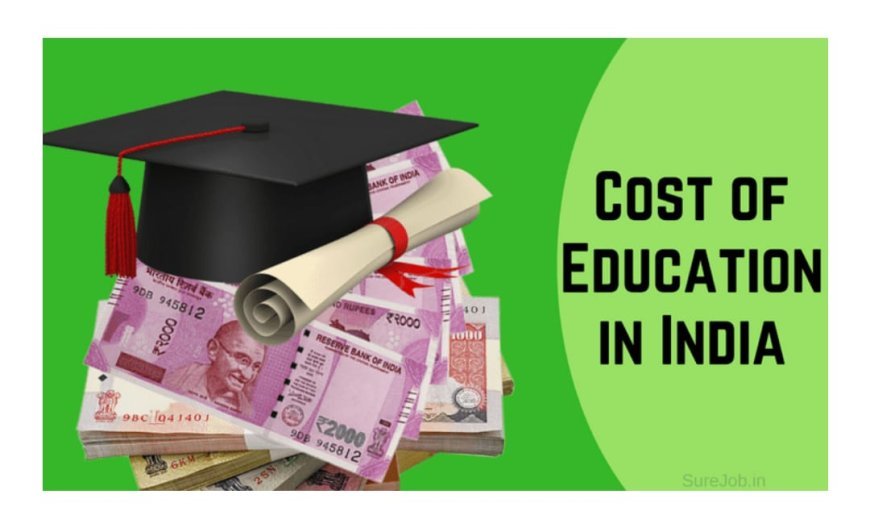
For a nation that prides itself on demographic dividend, the rising cost of education has become one of India’s most silent and severe crises. The promise of education as the great equaliser—once capable of lifting millions out of poverty—now feels increasingly hollow. From pre-primary to higher education, learning in India is rapidly turning into a luxury commodity, creating an ever-widening gap between those who can afford opportunities and those who cannot. What was once a basic right is slowly becoming a privilege.
At the heart of this problem lies a disturbing contradiction: India’s economy expands, the number of educational institutions grows, yet affordability drops every year. The poor and lower-middle classes are the worst hit, caught in a system that demands money for every rung of the upward mobility ladder.
The crisis begins extremely early. Even nursery-level admissions in urban and semi-urban India now involve hefty fees, ‘development charges,’ deposits, transportation costs, and mandatory uniforms purchased from select vendors. A child barely three years old enters a system already designed to extract. Parents often spend ₹50,000 to ₹1 lakh per year just to secure early schooling in private institutions because government schools—despite improvement efforts—are still plagued by inconsistent quality, teacher shortages, and infrastructural neglect. Poor and working-class families, who often earn less than ₹10,000 to ₹12,000 per month, are forced to choose between affordability and aspiration.
The Right to Education Act was envisioned to bridge this gap, ensuring free and compulsory education up to the age of 14. Yet, the implementation remains incomplete and inconsistent. Many private schools circumvent rules, government monitoring is weak, and the burden silently shifts back onto parents. For the poor, “free education” often still requires spending on books, uniforms, transport, and additional charges that accumulate into unaffordable sums.
As children grow older, the financial pressure intensifies. By the time they reach secondary school, tuitions and coaching classes become an unavoidable part of the journey. The education system, instead of preparing students in classrooms, has created a parallel shadow system where quality teaching happens only at a price. It is not uncommon for students in Class 9 or 10 to attend tuitions for multiple subjects, consuming precious income and time. For a working-class household, even ₹1,500 per subject becomes unaffordable—but competitive pressure makes it unavoidable.
The real blow arrives after Class 12. Whether a student pursues engineering, medicine, law, management, or even a humanities degree, higher education has become a financial ordeal. Government colleges remain limited in number, highly competitive, and often geographically inaccessible to rural or poorer students. Private colleges, meanwhile, charge fees that can rival global institutions without offering matching quality. Engineering courses in private institutes range between ₹80,000 to ₹2 lakh per year; medical education in private colleges often crosses ₹1 crore in total expenses. Even diploma and professional training programs, which were once affordable alternatives, now charge disproportionate fees.
This is where dreams collapse. The poorest students—often first-generation learners—find themselves locked out of opportunities because entrance exams, course fees, and living expenses create financial walls too high to scale. Education loans are difficult to access for families with unstable incomes or no collateral. Scholarships exist, but they remain limited and overburdened.
The tragedy is not just the absence of opportunity; it is the psychological weight of a system that tells the poor, year after year, that education is not built for them. When a talented student from a slum in Bhubaneswar or a small village in Odisha sees their peers giving up dreams because of fees, the message becomes painfully clear: ambition has a cost, and only some can afford it.
The commercialization of education has turned institutions into businesses. Schools and colleges advertise like corporate brands, focusing on luxury infrastructure instead of academic depth. Fancy buildings, air-conditioned classrooms, digital boards, and marketing strategies drive costs, while the core purpose of education—teaching, learning, and intellectual growth—often receives less attention. The richer the façade, the higher the fees.
Competitive exam coaching is another multi-crore industry thriving on parental anxiety. Kota, Hyderabad, and Bhubaneswar’s coaching hubs have become iron gates to top colleges. A student without coaching stands at a significant disadvantage. Fees for engineering or medical coaching often cross ₹1.5 lakh to ₹3 lakh per year—impossible for poor households. Even exams themselves come with registration fees that burden students applying for multiple options.
For the poor, this creates a triple burden: limited access, higher costs, and lower outcomes.
If India truly believes in equitable growth, the rising cost of education must be treated as a national emergency. The government must urgently expand and strengthen public education at every level. Well-funded government schools with trained teachers and digital infrastructure can challenge private school dominance. But reforms must go beyond classrooms—there must be transparency in fee regulation, monitoring of private institutions, and expansion of scholarships that cover not just tuition but full living costs.
Higher education needs radical restructuring. India needs more government-funded universities, especially in underserved regions. Entrance exams must be made accessible with free preparation resources, and loan systems should be more inclusive for poor families. Skill training and vocational education must become affordable and linked directly to job markets, not treated as secondary alternatives.
Above all, education must be restored to its original purpose—lifting people up, not keeping them out. The rising cost of education is not just an economic issue; it is a moral one. When a society makes learning unaffordable, it decides who gets to succeed. India cannot afford to let talent be dictated by income. The future of millions—and the nation itself—depends on building a system where education opens doors, not closes them.